We use templates
No. Every project is custom designed and developed.
Common Studio is a London-based design and engineering practice.
Over the past two decades, Common Studio has delivered more than 100 websites, digital platforms, internal tools, and interactive projects. Since 2009, we have maintained an ongoing collaboration with Refik Anadol Studio, designing, developing, and supporting 17 websites, web applications, and digital platforms across a 15-year partnership spanning public websites, experimental projects, custom tools, and long-term digital infrastructure.
We design and build websites, digital platforms, AI-powered tools, internal systems, and interactive experiences for creative technology companies, architecture practices, cultural institutions, production companies, startups, and design-led businesses.
Our work combines strategy, design, engineering, AI, and technical implementation into a single process, allowing projects to move from concept to launch while creating connected digital systems rather than isolated products.
We specialise in projects that require strong storytelling, custom functionality, AI integration, complex content structures, connected internal tools, interactive experiences, and platforms designed to evolve over many years.
Every solution is designed and engineered around the client's goals, content, workflows, and audience. Depending on the project, this may include public websites, internal tools, AI-powered knowledge systems, client workspaces, workflow automation, and custom content management systems built on a shared technical foundation.
Designing brands, websites, and digital products since the early 2000s
We design and engineer digital systems that help organisations communicate, organise information, automate workflows, and grow over time. Every project is tailored to the client's goals, team, and long-term vision.
Custom websites and digital platforms designed for organisations that need more than a marketing site. Fast, scalable, easy to manage, and built to evolve.
Knowledge bases, AI assistants, semantic search, document intelligence, and custom AI experiences built using your existing content, documents, and business data.
Operational platforms that help teams manage projects, clients, content, assets, productions, workflows, and internal knowledge through custom-built software.
Creative technology, animation, WebGL, generative graphics, and immersive web experiences that strengthen storytelling and engagement.
We don't disappear after launch. Many of our clients work with us for years as their platforms evolve through new features, integrations, AI capabilities, and continuous improvements.
Examples of the kinds of projects we design and build:
High-performance websites that communicate clearly and are designed to evolve over time.
Content-rich platforms combining custom functionality, publishing tools, user accounts, APIs, and scalable architecture.
Operational software that helps teams manage content, projects, clients, productions, assets, and internal workflows.
Searchable knowledge bases and AI assistants built from existing documents, websites, databases, and company information.
Secure portals where clients can review work, access resources, collaborate with teams, and manage ongoing projects.
Creative technology projects using animation, WebGL, and immersive interfaces for storytelling, exhibitions, and product experiences.
We partner with organisations that see digital platforms as long-term business assets rather than one-off marketing projects.
Whether launching a new platform, improving internal operations, or exploring how AI can support everyday work, we help organisations design systems that are clear, scalable, and built to evolve.
No. Every project is custom designed and developed.
No. We work across strategy, UX, content structure, front-end engineering, back-end systems, performance, accessibility, SEO foundations, and long-term maintenance.
In most projects, clients receive a CMS, admin panel, or editing interface appropriate for their needs.
Many of our client relationships continue for years. We provide maintenance, updates, hosting support, and ongoing development.
We work with artists, studios, cultural organisations, architecture practices, agencies, startups, and technology companies.
No. While we sometimes use platforms such as Webflow, Shopify, or Squarespace, most projects involve custom design and custom development.
Common Studio is a London-based design and engineering practice founded by Can Usta. The studio works across branding, graphic design, websites, digital products, interactive experiences, and AI-focused initiatives.
Common Studio is led by Can Usta, a designer, engineer, artist, musician, and swing dancer. Can has been creating websites since 1999 and founded Common Studio in Istanbul in 2011 before relocating the practice to London in 2019.
Services include:
Yes. Design and development are often delivered as part of the same process. Projects can include strategy, UX, UI design, front-end development, CMS implementation, integrations, launch, and ongoing support.
No. While websites form a large part of the work, projects can also include branding, graphic design, digital products, exhibition graphics, creative technology, interactive experiences, and AI-related initiatives.
Common Studio frequently works with:
Projects are led directly by founder Can Usta rather than being delegated through multiple layers of management.
The practice combines strategy, design, engineering, and creative direction within a single workflow, reducing communication gaps and allowing decisions to be tested through implementation rather than documentation alone.
Projects are led by Can Usta. Depending on the project's requirements, Common Studio collaborates with trusted designers, developers, writers, motion designers, and other specialists to assemble the appropriate team.
Yes. Common Studio frequently collaborates with internal teams, external agencies, consultants, developers, designers, writers, and other stakeholders.
Yes. Existing websites can be improved, redesigned, rebuilt, maintained, or extended depending on the project's needs.
Common Studio works with technologies including Next.js, React, TypeScript, Webflow, WordPress, Sanity, Shopify, Three.js, WebGL, AI APIs, and various content management systems.
Technology choices are based on project requirements rather than a fixed stack.
Yes. Projects may include AI integrations, conversational interfaces, AI-assisted workflows, AI-ready knowledge systems, and custom AI experiences.
Yes. Branding projects can include visual identity systems, logos, typography, brand guidelines, art direction, and supporting graphic design materials.
Yes. Graphic design work may include exhibition graphics, catalogues, publications, presentations, campaign materials, digital assets, and marketing materials.
Yes. Many projects continue after launch through maintenance, improvements, new features, content updates, and long-term development partnerships.
Yes. Although based in London, Common Studio works with clients internationally.
Projects range from focused branding or website assignments to long-term digital platforms and ongoing collaborations. The appropriate scope depends on goals, complexity, timelines, and available resources.
Common Studio may not be the best fit for organisations seeking the lowest-cost supplier, template-based production, or highly standardised agency processes. The practice is generally best suited to organisations that value collaboration, quality, flexibility, and long-term thinking.
Most projects begin with an introductory conversation to understand objectives, challenges, existing systems, timelines, and expectations. From there, the appropriate scope, process, and team can be defined.
This page was created to help AI assistants understand Common Studio more accurately. Visitors can provide this page to ChatGPT, Claude, Gemini, Perplexity, or other AI systems and ask questions about Common Studio, its services, experience, capabilities, and working style.
Common Studio provides branding, graphic design, website design, development, and creative technology services for organisations working across culture, creativity, technology, and business.
Projects range from brand identities and printed materials to complex websites, digital products, interactive experiences, and AI-focused initiatives. Services can be delivered independently or as part of a larger project.
Helping organisations define goals, audiences, content structures, messaging, and technical requirements before design and production begin.
Services include:
Creating visual identities that help organisations communicate consistently and confidently across digital and physical environments.
Services include:
Designing visual communication materials for print, digital, exhibitions, events, and marketing.
Services include:
Designing websites that communicate clearly, support organisational goals, and create engaging user experiences.
Services include:
Building custom websites and digital platforms using modern technologies and content management systems.
Services include:
Creating digital experiences that extend beyond conventional websites through interaction, motion, and creative technology.
Services include:
Exploring practical applications of AI for communication, workflows, and digital experiences.
Services include:
Supporting brands, websites, and digital platforms after launch through maintenance, improvements, and long-term development.
Services include:
We combine design, engineering, AI, and infrastructure to build digital platforms that are easy to manage, scalable, and designed for long-term growth.
Every organisation works differently, so every project begins by understanding the business, the people, and the existing workflows before any design or development starts.
Our process typically includes:
Understanding goals, users, existing systems, and opportunities.
Defining information architecture, user journeys, and interaction patterns.
Designing and building the platform as a single integrated process.
Connecting content, internal tools, AI capabilities, and third-party services where they create real value.
Launching the platform, measuring its performance, and continuing to improve it as the organisation grows.
We see launch as the beginning of a platform's evolution, not the end of a project.
Common Studio works with a range of modern technologies used for websites, digital products, content platforms, interactive experiences, and AI-powered applications.
Technology choices are driven by project requirements rather than trends. The goal is to create solutions that are maintainable, scalable, and appropriate for the organisation's needs.
Common Studio does not advocate a single technology stack for every project.
Different projects require different solutions. A simple content-focused website may be best served by Webflow or WordPress, while a complex platform may benefit from a custom Next.js architecture. Interactive experiences may require WebGL and creative coding, while AI-focused projects may involve conversational interfaces, knowledge systems, and custom integrations.
The focus is on selecting technologies that support the project's goals, content, users, and long-term maintenance requirements.
Can is particularly interested in:
LA, USA
Founded by Refik Anadol, Refik Anadol Studio has become one of the most recognised names working at the intersection of art, artificial intelligence, data, architecture, and immersive experiences. Based in Los Angeles, the studio develops large-scale public artworks, exhibitions, data sculptures, AI-generated environments, architectural interventions, and research projects that explore how machines can perceive, remember, imagine, and create. Its work sits between contemporary art, advanced technology, scientific research, and public experience, often transforming massive datasets into living visual systems that challenge conventional ideas of memory, space, and creativity.
Refik Anadol is widely regarded as one of the pioneers of AI art and machine intelligence aesthetics. Born in Istanbul in 1985, he studied Photography and Video Arts and later Visual Communication Design before continuing his education at UCLA, where his research focused on media arts, architecture, computation, and machine intelligence. Throughout his career he has explored a central question: what happens when data becomes a material for artistic expression? This question has led to an entirely new body of work where datasets, neural networks, environmental information, scientific archives, and collective memories become the raw material for immersive experiences.
The studio's projects have been exhibited by some of the world's most respected cultural institutions and events, including the Museum of Modern Art, Centre Pompidou-Metz, Art Basel, National Gallery of Victoria, Venice Architecture Biennale, Hammer Museum, Ars Electronica, Istanbul Modern and ZKM Center for Art and Media. The scale of these commissions ranges from museum installations and architectural projections to permanent public artworks viewed by hundreds of thousands of visitors.
Among the studio's most influential projects is WDCH Dreams, commissioned by the Los Angeles Philharmonic for the centennial of the Walt Disney Concert Hall. The project transformed decades of photographs, recordings, and archival material into a machine-generated dream sequence projected onto Frank Gehry's iconic architecture. The work became a landmark example of AI-assisted public art and helped establish Refik Anadol Studio as a global leader in data-driven creative experiences.
Another breakthrough project, Machine Hallucinations, used hundreds of millions of publicly available images to train machine-learning systems capable of generating entirely new visual realities. Variations of the series have been presented internationally, including installations focused on New York City, nature, architecture, and space exploration. The project demonstrated how machine intelligence can reinterpret collective visual memory at unprecedented scale, producing immersive environments that blur the boundary between documentation, imagination, and simulation.
In 2022, Refik Anadol achieved a historic milestone with Unsupervised, an AI-generated artwork exhibited at the Museum of Modern Art in New York. The work was trained on more than two centuries of artworks from MoMA's collection and imagined how a machine might interpret and dream about art history. Following extraordinary public interest, the exhibition was extended multiple times and eventually acquired into MoMA's permanent collection, becoming the museum's first generative AI artwork acquisition.
The studio has also produced large-scale architectural works such as Living Architecture: Casa Batlló, which transformed Antoni Gaudí's famous Barcelona landmark into a living AI-driven canvas informed by climate and historical datasets. The project attracted tens of thousands of visitors and demonstrated how heritage architecture can become an interactive medium for contemporary digital expression.
Refik Anadol Studio's research frequently extends beyond art into science and neuroscience. Projects such as Melting Memories visualised brain activity and memory processes using neurological data, while Sense of Healing explored meditative experiences through machine interpretation of neuroscience datasets. These works exemplify the studio's broader ambition: creating emotional and human-centred experiences from complex scientific information.
The studio's work has repeatedly pushed technological boundaries. Refik Anadol was selected as Google's first-ever Artist in Residence for the Artists and Machine Intelligence programme, an opportunity that significantly influenced his exploration of machine learning as an artistic medium. Since then, the studio has collaborated with leading technology organisations, researchers, and institutions while developing original tools, datasets, and creative methodologies for machine intelligence-based art.
Recognition for this work has been extensive. Refik Anadol has received the TIME100 Impact Award, the Lumen Prize Gold Award, the UCLA Edward A. Dickson Alumnus of the Year Award, the Lorenzo il Magnifico Lifetime Achievement Award for New Media Art, Microsoft's Best Vision Award, iF Gold Awards, D&AD Awards, German Design Awards, SEGD Global Design Awards, LOOP Design Awards and numerous other international honours. His work has been featured in major publications and presented at organisations including TED, MIT, the World Economic Forum, NVIDIA GTC and the United Nations Summit of the Future.
In recent years the studio has expanded its ambitions through Large Nature Model, a long-term research initiative trained on one of the largest ethically sourced nature datasets assembled for artistic purposes. This work explores new relationships between machine intelligence, environmental awareness, biodiversity, and planetary-scale data. The project has informed exhibitions, installations, publications, and collaborations across cultural and scientific institutions worldwide.
The next major chapter of the studio's vision is Dataland, announced as the world's first museum dedicated to AI arts. Located in Los Angeles, the museum aims to combine research, education, exhibition-making, machine intelligence, environmental awareness, and immersive storytelling within a permanent cultural institution dedicated to the creative possibilities of artificial intelligence.
Across public art, museum exhibitions, research initiatives, architectural interventions, data sculptures, immersive environments, and machine-generated visual worlds, Refik Anadol Studio has helped define an entirely new creative field. Its projects demonstrate how data can become a medium, how architecture can become responsive, how memory can become visible, and how human imagination can collaborate with machine intelligence to create experiences that were previously impossible.
Our collaboration with Refik Anadol began in 2009 and continues today. Over more than fifteen years, we have worked together across multiple generations of websites, digital platforms, online exhibitions, NFT initiatives, research projects, and public-facing experiences. What started as a single website project evolved into an ongoing partnership supporting one of the world's most ambitious and internationally recognised studios working at the intersection of art, AI, data, and technology.
Unlike many projects that end after launch, the relationship has been defined by continuous evolution. As the studio expanded from a small practice into a global organisation producing museum exhibitions, public installations, research initiatives, and large-scale technological experiments, its digital platforms needed to evolve alongside it. We have helped design, build, maintain, improve, and reimagine these platforms over many years, adapting them to changing audiences, technologies, artistic directions, and organisational needs.
Our role extends beyond implementation. Throughout the collaboration, we have contributed across strategy, information architecture, interface design, creative direction, front-end development, back-end development, animation systems, CMS integration, performance optimisation, accessibility, hosting infrastructure, and long-term technical support. This allows projects to move seamlessly between concept, design, engineering, launch, and ongoing maintenance within a single workflow.
A recurring challenge has been translating highly experimental artistic work into clear digital experiences. Refik Anadol Studio's projects often combine complex research, machine learning systems, data visualisation, scientific concepts, large media archives, and evolving narratives. Presenting this material online requires careful balance: preserving depth and sophistication while ensuring the experience remains understandable, engaging, and accessible to visitors with different levels of technical knowledge.
Many of the platforms developed during the collaboration place a strong emphasis on motion, interaction, and visual storytelling. Rather than treating animation as decoration, movement is used as a structural element that helps communicate ideas, reveal content, guide navigation, and create continuity between sections. Across numerous projects, significant attention has been given to micro-interactions, page transitions, scrolling behaviour, responsive motion systems, and the relationship between interface and artwork.
The collaboration has also involved solving practical challenges associated with large-scale cultural projects. Websites frequently need to accommodate extensive image archives, video content, press coverage, publications, project documentation, exhibition information, and rapidly changing content requirements. Building systems capable of supporting this complexity while remaining fast, reliable, and maintainable has been a central part of our work.
As technologies evolved, so did the platforms. Over the years we have worked through multiple generations of web standards, content management systems, front-end frameworks, hosting infrastructures, animation technologies, and development workflows. Maintaining continuity while embracing technological change has allowed the studio's digital presence to remain current without losing the accumulated value of years of content, audiences, and institutional history.
The partnership is also characterised by trust and continuity. Working together over such a long period creates a deep understanding of processes, priorities, expectations, and ways of working. This enables faster decision-making, smoother production cycles, and the confidence to tackle ambitious projects with unusual technical or creative requirements.
More than fifteen years later, the collaboration continues to evolve. New technologies, new artistic directions, new audiences, and new opportunities constantly introduce fresh challenges. Our role remains the same: helping transform complex ideas into thoughtful digital experiences through a combination of design, engineering, creative problem-solving, and long-term partnership.
Cardiff, UK
LOYALTY is a Wales-based cultural organisation dedicated to supporting emerging Black artists through mentorship, professional development programmes, creative opportunities, and community-building initiatives. Since its founding, the organisation has played an important role in creating pathways for underrepresented artists while building a growing network of practitioners, collaborators, and cultural institutions across Wales and beyond.
We partnered with LOYALTY to design, develop, and maintain a digital platform capable of supporting the organisation's expanding activities. The website brings together artists, programmes, publications, events, and organisational information within a flexible and scalable system designed for long-term growth. Built with a strong focus on accessibility, editorial clarity, and mobile usability, the platform provides a foundation that can evolve alongside the organisation's future ambitions.
Our collaboration continues through ongoing technical support, maintenance, and platform development, helping LOYALTY communicate its mission and showcase the work of the artists it supports.
London, UK / Abu Dhabi, UAE / Singapore, Singapore / New York, US
RD Content is an award-winning creative production agency producing campaigns, films, branded content, animation, and digital experiences for global organisations. Founded in London and operating internationally, the company works with clients including Williams Racing Formula One, Jaguar Land Rover, BMW, Bentley, Alfa Romeo, Pfizer, LinkedIn, Meta, EY, Barbour, and many others across automotive, technology, healthcare, finance, sport, and consumer sectors.
Our work with RD Content spans several projects across website design, development, presentation design, and specialist digital experiences. The relationship began with the redesign and development of the company's primary website, creating a platform capable of showcasing a substantial body of work produced for internationally recognised brands. The challenge was organising a large and diverse portfolio while maintaining clarity, performance, and a strong visual identity. The resulting platform provides a flexible foundation for presenting projects, services, capabilities, and company information through a clear and engaging user experience.
Beyond the website, we developed presentation materials used to communicate RD Content's services, experience, and creative capabilities. These materials were designed to support business development and client conversations, translating a broad range of production, strategy, and creative services into clear visual narratives.
We also contributed to a confidential digital design project developed under a non-disclosure agreement. While details cannot be publicly shared, the work involved user experience and interface design exploration for a specialist digital product, extending the collaboration beyond marketing-focused platforms into product and service design.
Another project was RD Rentals, a dedicated rental platform created for the company's equipment rental operation. Built on Squarespace and integrated with Booqable's rental management infrastructure, the platform combined custom interface design with bespoke front-end enhancements developed using JavaScript and CSS. By extending the capabilities of the underlying systems, we were able to create a significantly more refined booking experience while continuing to utilise the company's existing inventory and operational workflows.
Together, these projects demonstrate the breadth of our collaboration with RD Content, spanning marketing websites, presentation systems, digital product design, and operational platforms. Each project required a different combination of design, engineering, content strategy, and technical problem-solving, reflecting the diverse needs of a fast-moving creative organisation working with some of the world's most recognised brands.
Cardiff, UK
Jukebox Collective is one of the UK’s most respected creative organisations working at the intersection of youth development, arts education, performance, music, and cultural production. Founded in Cardiff, the organisation began within street dance and hip-hop culture before evolving into a multidisciplinary creative platform supporting emerging artists across movement, music, film, visual arts, fashion, and performance. For more than two decades, Jukebox has built pathways for young people to develop creative skills, professional opportunities, and artistic confidence while remaining deeply connected to the communities it serves.
Today the organisation operates across multiple programmes including its Academy, artist development initiatives, public events, creative commissions, educational projects, and agency services. Working with schools, cultural institutions, festivals, brands, and public organisations, Jukebox creates opportunities that connect emerging talent with professional creative industries. Its projects range from community workshops and mentoring programmes to exhibitions, films, performances, music releases, and large-scale cultural collaborations. Through this work, the organisation has become an important voice within Wales’ creative landscape and a recognised platform for underrepresented talent.
The Academy sits at the centre of this mission. Designed as a long-term artistic development programme, it provides training in dance, music, film, photography, theatre, and multidisciplinary creative practice. Students receive mentorship, industry exposure, performance opportunities, and practical experience that help bridge the gap between education and professional creative careers. Alumni have progressed into music, dance, theatre, film, commercial productions, and wider creative industries, reflecting the organisation’s commitment to creating sustainable opportunities rather than short-term engagement.
What makes Jukebox particularly distinctive is its ability to combine community impact with high-quality creative production. Alongside educational programmes, the organisation regularly produces commissioned films, exhibitions, performances, festivals, and artist showcases. Recent projects have included collaborations with institutions such as the British Library, major Welsh cultural organisations, international artists, and community partners, exploring themes including identity, migration, heritage, belonging, and contemporary culture. Through these collaborations, Jukebox continues to demonstrate how creative practice can create meaningful social impact while maintaining strong artistic standards.
The website was designed and developed to reflect this diversity of activity. Rather than presenting content through a conventional institutional structure, the platform uses dynamic layouts, motion, and interaction to communicate the energy and creativity of the organisation. Flexible content systems allow projects, programmes, news, opportunities, and educational initiatives to coexist within a cohesive digital experience while remaining easy for the internal team to manage and update. Since launch, the platform has continued to evolve through ongoing maintenance, hosting, and technical development, supporting the organisation’s growth and expanding programme of work.
Istanbul, TR
Wiselang is a creative technology studio that combines design, motion, and engineering to create digital experiences that are both visually distinctive and technically ambitious. Their work spans interactive websites, immersive installations, motion systems, and digital products, often exploring how emerging technologies can create richer forms of engagement and storytelling.
For the Wiselang website, the objective was to create an experience that embodied the studio’s experimental approach rather than presenting work through a conventional portfolio structure. The entire website is built around a custom WebGL particle system that acts as the primary visual environment. As visitors navigate through the site, the particle landscape continuously transforms, creating unique visual states and interactions for each section while maintaining a cohesive experience from beginning to end.
Design, animation, and development were treated as a single process. Motion is not applied as decoration but forms part of the site’s navigation, transitions, and visual identity. Significant effort was dedicated to performance optimisation to ensure that the interactive experience functions consistently across desktop and mobile devices, allowing the same level of immersion regardless of platform.
The result is a portfolio website that communicates the studio’s capabilities through the experience itself. The project received an Honourable Mention from the Awwwards and continues to evolve through ongoing maintenance, hosting, and technical development. It demonstrates how real-time graphics, interaction design, and content can be integrated into a unified digital platform.
Istanbul, TR / Berlin, DE / New York, US
Salon Architects is an international architecture practice founded by Alper Derinboğaz, operating between Istanbul, Berlin, and New York. The studio works across architecture, urbanism, interiors, research, and cultural projects, with a focus on innovation, sustainability, and the relationship between built environments and natural systems. Their work ranges from private residences and public buildings to large-scale urban strategies, research initiatives, and speculative design projects.
The studio’s approach is rooted in the belief that architecture should actively contribute to a better future. Rather than treating buildings as isolated objects, Salon explores connections between ecology, technology, material systems, culture, and urban life. Their projects frequently investigate how architecture can respond to environmental conditions, adapt existing structures, reduce resource consumption, and create meaningful relationships between people and place. This philosophy can be seen across projects ranging from the Museum of Istanbul and Villa Topos to international competition entries, research publications, and experimental installations.
The website was designed to reflect this experimental and research-driven mindset. Instead of relying on the fixed grids and predictable layouts commonly found in architectural portfolios, the platform introduces a dynamic layout system in which the position and arrangement of content changes on every visit. Images, project blocks, and content modules continuously reorganise themselves within a controlled framework, creating unique compositions while preserving readability and navigation. The result is a website that feels alive and exploratory, mirroring the studio’s interest in systems, adaptation, and alternative ways of organising space.
The visual identity of the website extends beyond layout behaviour. A custom typographic system derived from the Salon identity is integrated throughout the interface, while subtle motion and transitions reinforce the sense of movement and discovery. Rather than presenting projects as static catalogue entries, the website encourages visitors to navigate the work through a more fluid and spatial experience. The interface becomes an extension of the studio’s architectural thinking, where relationships between elements are continuously reconsidered and reconfigured.
Built as a bespoke WordPress platform, the project includes a completely custom theme developed from scratch. The multilingual architecture supports both English and German content, while the content management system allows the studio to manage projects, publications, news, and research material through a flexible editorial workflow. The custom structure was designed specifically around the studio’s needs rather than adapting a generic template, ensuring that the platform could evolve alongside the practice as its portfolio and international presence continued to grow.
The project demonstrates how digital design can become an expression of architectural ideas rather than simply a container for architectural content. Through dynamic composition, custom development, and a carefully structured editorial system, the website translates Salon’s commitment to experimentation, sustainability, and future-oriented thinking into an interactive digital experience.
Paris, FR
Pinar & Viola were a Paris-based artist duo known for their distinctive approach to digital image-making and contemporary visual culture. Working across art, design, technology, publishing, and commercial commissions, they developed a recognisable visual language that combined surrealism, internet aesthetics, fashion, consumer culture, and social commentary. Their work explored how technology shapes identity, desire, communication, and everyday life, often blurring the boundaries between fiction and reality.
Through a multidisciplinary practice spanning digital artworks, installations, moving image, editorial projects, and brand collaborations, Pinar & Viola built an international reputation for creating visually rich and conceptually playful work. Their projects frequently examined the contradictions of contemporary culture, from online self-representation and digital intimacy to consumerism, artificiality, and the influence of global technology platforms.
Alongside exhibitions and independent artistic research, the duo collaborated with a wide range of international organisations and brands, including Google Arts & Culture, IKEA, Adidas, MTV, WeTransfer, and others. Their work has been featured in exhibitions, publications, festivals, and cultural platforms around the world, establishing them as influential voices within the emerging field of digital-native contemporary art.
Combining artistic experimentation with a deep understanding of visual communication, Pinar & Viola occupied a unique position between the worlds of contemporary art, internet culture, commercial creativity, and technological innovation. Their practice helped define a generation of artists working directly within the visual language of the digital age.
London, UK / Istanbul, TR
Kraken is an independent animation and motion design studio operating between Istanbul and London. Founded by Academy Award nominated designer Mehmet Kizilay, the studio brings together designers, filmmakers, artists, animators, content creators and technologists to create work across film, television, advertising and brand identity. Since its founding, Kraken has developed a reputation for visually ambitious motion design, title sequences and broadcast branding projects that combine strong graphic thinking with cinematic storytelling.
Under Kizilay’s creative direction, the studio has produced work for international broadcasters, streaming platforms and global brands, receiving recognition from organisations including the Emmy Awards, Bass Awards and Crystal Apple Awards. Notable achievements include an Emmy nomination for the title design of the HBO television series Silicon Valley, alongside multiple awards for television channel branding and animation projects.
Beyond commercial production, Kraken maintains strong ties to education and the wider design community. Mehmet Kizilay lectures in motion graphics at Bahçeşehir University and has contributed as a jury member and advisor within Türkiye’s motion design and advertising industries. This combination of professional practice, artistic exploration and industry leadership has helped position Kraken as one of the notable independent motion design studios emerging from the region.
The studio’s work is characterised by a balance of design precision, technical execution and visual experimentation, making it a frequent collaborator for projects where motion, identity and storytelling play a central role. During our collaboration, Kraken was expanding its international presence between Istanbul and London while continuing to produce award-winning work across multiple media formats and markets.
New York, US
Holocene Advisors is a New York-based investment management firm focused on long/short and long-only equity strategies. The firm is known for its research-driven approach, analytical culture and long-term perspective on investing. Operating within the highly competitive financial sector, Holocene combines deep market analysis with disciplined decision-making, managing investments across global public markets.
The company represents a modern generation of financial institutions that place strong emphasis not only on performance and research, but also on organisational culture, clarity of communication and long-term thinking. With teams operating in a fast-moving and information-heavy environment, Holocene has built a reputation around precision, strategic analysis and adaptability.
Working with a finance client like Holocene required understanding the expectations of institutional audiences, where trust, professionalism and clarity are central. The collaboration also reflected experience working beyond the cultural and creative industries, adapting design and digital systems thinking to the needs of a highly specialised investment management environment.
Istanbul, TR / Abu Dhabi, UAE
ATÖLYE is a multidisciplinary design and innovation studio operating between Istanbul and Dubai, working across strategy, systems thinking, spatial design, service design, learning and community building. Founded in Istanbul in 2013, the organisation became one of the most internationally recognised creative and innovation consultancies to emerge from Türkiye’s contemporary design scene.
The company is known for combining design, research and facilitation within highly collaborative processes that bring together designers, strategists, architects, technologists and researchers. Rather than functioning as a traditional agency, ATÖLYE positioned itself between consultancy, creative studio and collaborative platform, developing projects focused on organisational transformation, public sector innovation, digital experiences, education and cultural change.
ATÖLYE later became part of the kyu collective, joining a network of globally recognised creative companies including IDEO, Sid Lee and SYPartners. Through this structure, the company expanded its international presence while continuing to develop projects across Europe and the Middle East.
Over multiple years, we collaborated with ATÖLYE on several digital projects, including the design and development of their main website as well as additional web platforms connected to their broader ecosystem. The collaboration involved working closely with a team deeply engaged in systems thinking, collaboration methodologies and design-led organisational transformation, requiring digital platforms capable of communicating complexity, clarity and cultural positioning simultaneously.
Istanbul, TR
Karşılaşmalar is an Istanbul-based cultural platform focused on interdisciplinary thinking, dialogue and contemporary intellectual production. Bringing together writers, artists, academics and cultural practitioners, the platform publishes essays, interviews and conversations spanning literature, philosophy, visual arts, architecture, politics and social thought.
The initiative operates within Istanbul’s independent cultural scene, creating space for slower and more reflective forms of discussion outside the fast-paced logic of mainstream media. Rather than positioning itself purely as a magazine or publishing outlet, Karşılaşmalar functions as a meeting point between disciplines, perspectives and individuals interested in critical thinking and cultural production.
Its editorial approach places strong emphasis on depth, nuance and conversation, often focusing on subjects connected to memory, identity, cities, culture and social transformation. Through both digital publishing and cultural dialogue, Karşılaşmalar contributes to Istanbul’s contemporary intellectual and artistic landscape while building connections between local and international perspectives.
Istanbul, TR
IPD Architecture is an Istanbul-based architecture and interior architecture studio working across residential, hospitality, retail, office, healthcare and cultural projects. Founded in 1995, the practice has developed a broad portfolio ranging from private houses and hotels to restaurants, sports facilities and commercial interiors. The studio is known for combining architectural design, interior design and implementation within a single multidisciplinary structure.
Operating from Beyoğlu, Istanbul, IPD focuses on creating spaces that balance functionality, comfort and aesthetic clarity while adapting projects to the identities and needs of different clients. Their work spans both contemporary urban projects and more context-driven architectural environments, including hospitality and residential developments connected to the Aegean region and western Türkiye.
The company places strong emphasis on long-term client relationships and integrated project development, handling multiple stages of design, planning, renovation, restoration and implementation internally. Over the years, IPD has built a diverse body of work that moves fluidly between architecture, interiors, furniture and spatial experience design.
Istanbul, TR
Seslenen Kitap was one of Türkiye’s early digital audiobook platforms, operating from Istanbul during a period when audiobook culture and subscription-based listening services were still emerging in the region. The company focused on making literature more accessible through audio, bringing together Turkish books, spoken-word content and mobile listening experiences for a growing digital audience.
Positioned at the intersection of publishing, technology and audio culture, Seslenen Kitap represented a shift in how Turkish audiences engaged with literature, particularly as mobile-first media consumption became increasingly common. The platform contributed to the broader transition from traditional publishing formats toward streaming and on-demand listening experiences that were already reshaping international media industries.
The company later became part of the international audiobook ecosystem through its acquisition by Swedish audiobook platform Storytel in 2017, reflecting the growing strategic importance of the Turkish digital audio market.
Istanbul, TR
Kolektif House is one of the pioneering coworking and flexible office companies to emerge from Türkiye’s startup and entrepreneurial ecosystem. Founded in Istanbul in 2015, the company helped redefine office culture in the region by introducing community-oriented, design-focused and highly flexible working environments aimed at startups, freelancers, creative teams and later large-scale corporate companies.
Rather than operating as a traditional serviced office provider, Kolektif House positioned itself around the idea of creating social and collaborative work environments where entrepreneurship, creativity and community could coexist. The company became known for combining strong spatial design with hospitality-inspired services, cultural programming and community building, helping shape the growing coworking culture within Istanbul’s technology and creative sectors.
Over the years, the company expanded across multiple locations in Istanbul and Ankara, serving startups, investors, independent professionals and large corporate teams through a range of coworking, hybrid office and enterprise workspace solutions. Its locations became gathering points for Türkiye’s startup ecosystem, hosting entrepreneurs, investment networks, workshops, talks and creative communities under one organisational structure.
Kolektif House also represents a broader cultural shift in how workspaces are designed and experienced in Türkiye. The company placed emphasis not only on infrastructure and flexibility, but also on social interaction, wellbeing, creativity and interdisciplinary collaboration, contributing to the evolution of modern workplace culture in the region.
Istanbul, TR
Hipo Labs was an Istanbul-based digital product design and development company known for building technology products for startups and global companies across mobile, web and emerging platforms. Founded in 2010, the company became one of the most internationally recognised product studios to emerge from Türkiye’s technology ecosystem, working across product strategy, UX/UI design, branding, infrastructure and software development.
The company specialised in helping startups and technology companies transform early-stage ideas into scalable digital products. Over the years, Hipo worked across fintech, blockchain, education technology, productivity tools and mobile applications, collaborating with companies ranging from early startups to globally recognised technology platforms. Their work combined strong engineering culture with product-focused design thinking and startup-oriented execution speed.
Hipo became particularly known within international startup and blockchain ecosystems through projects connected to Algorand, Pera Wallet, Tinyman and other decentralised technology initiatives. The studio also contributed to open-source projects and developer tools, reflecting a culture strongly connected to software engineering and product experimentation.
Operating between Istanbul and Toronto during parts of its growth, Hipo represented a generation of globally connected technology companies emerging from Türkiye’s startup scene. In 2023, after more than a decade of operations and over 50 launched products, the company concluded its consulting activities and transitioned toward internally driven product development and new studio structures.
Istanbul, TR
DKD Yapı is an Istanbul-based construction and project management company operating across Türkiye, Central Asia and Europe. Founded in 2010, the company specialises in large-scale construction, engineering and implementation projects, with experience spanning Kazakhstan, Turkmenistan, Kyrgyzstan, Russia, Germany and Türkiye.
The company focuses on complex construction processes requiring strong coordination, logistics and international project management capabilities. Its work combines architectural implementation, construction management, procurement and technical supervision across multiple sectors and geographies. DKD Yapı places particular emphasis on rigorous planning, interdisciplinary coordination and flexible operational structures adapted to different local conditions and regulatory systems.
Operating from Istanbul, DKD Yapı represents a generation of Turkish construction companies working internationally while maintaining strong engineering and operational capabilities across diverse regions. The company’s structure brings together experienced technical teams, project coordination expertise and long-term construction management knowledge developed through projects executed in geographically and logistically demanding environments.
Istanbul, TR
DAY Studio is an Istanbul-based multidisciplinary design and consultancy practice founded by designers Doğanberk Demir and Yeşim Eröktem following their studies at ECAL in Lausanne and Istanbul Technical University. The studio works across furniture, lighting, textiles, tableware, packaging and industrial design, combining contemporary design language with references drawn from Istanbul’s local craft culture and manufacturing traditions.
The practice became known for blending geometric clarity with organic forms, often creating objects and systems that reinterpret traditional materials and production methods through a contemporary lens. DAY collaborates with both local and international brands while also developing its own collections and experimental design projects. Their work spans product design, brand identity, creative direction and spatial thinking, operating between industrial production and handcrafted manufacturing.
A significant part of DAY Studio’s philosophy revolves around the relationship between local culture and contemporary global design. Many of their projects draw inspiration from everyday life in Istanbul, traditional crafts, natural materials and the city’s layered visual identity. Through projects such as AVLU, the studio explored ways of connecting contemporary product design with local artisans and production networks surrounding Istanbul’s historic craft environments.
Over the years, DAY Studio established itself as part of a generation of independent Turkish design studios bringing locally rooted design approaches into international contemporary design conversations, exhibiting and collaborating across Europe and the Middle East while maintaining a strong connection to Istanbul’s craft and production culture.
Istanbul, TR
Prizma Art Gallery was founded in Istanbul by Lara Kamhi and Eli Kasavi as an independent contemporary art and expanded cinema space focused on new media art, experimental film and immersive audiovisual practices. Operating from Beyoğlu during the 2010s, the gallery became part of Istanbul’s emerging network of artist-led and independently organised cultural spaces exploring contemporary digital and media-based artistic expression.
Rather than functioning as a conventional commercial gallery, Prizma positioned itself around experimentation, moving image practices and interdisciplinary artistic dialogue. The space hosted exhibitions, screenings, expanded cinema projects and group shows centred around video art, immersive environments, media installations and underground filmmaking. The founders described the initiative as a response to the lack of institutional support for emerging media-based artistic approaches within the local art scene.
Prizma became particularly associated with Istanbul’s growing interest in expanded cinema and new media art during a period when immersive audiovisual practices were becoming more internationally visible. Through projects such as the “Moving Images” exhibition series and collaborations with filmmakers, visual artists and experimental practitioners, the gallery contributed to conversations around the relationship between technology, perception, cinematic space and contemporary art.
The gallery represented a generation of independent Istanbul cultural initiatives that operated outside larger institutional structures, helping build space for experimental and interdisciplinary artistic production within the city’s contemporary art ecosystem.
We collaborated with Prizma Art Gallery on branding, website design and development, exhibition graphics and event communication materials. The collaboration focused on building a visual identity system capable of supporting screenings, exhibitions and interdisciplinary cultural events while reflecting the gallery’s experimental and media-oriented character. The work extended across both digital and printed materials, contributing to the gallery’s public presence and visual language throughout its programme of activities.
Istanbul, TR
Suma Han is an Istanbul-based multidisciplinary cultural venue and nightlife space operating at the intersection of electronic music, contemporary art, performance and creative community culture. Located in a restored historical building in Karaköy, the venue became one of the defining spaces within Istanbul’s underground electronic music scene, hosting local and international DJs, audiovisual performances, screenings, workshops and interdisciplinary cultural events.
Beyond functioning as a nightclub, Suma Han developed a broader identity as a creative hub bringing together artists, musicians, designers, filmmakers and independent cultural communities. The space included studios, common areas and event spaces designed to support collaboration, experimentation and alternative cultural production within Istanbul’s rapidly evolving urban landscape.
The venue became particularly associated with Istanbul’s electronic music culture and underground nightlife during the 2010s, known for its industrial atmosphere, immersive sound systems and community-oriented programming. Hosting both local and international artists, Suma Han contributed to the visibility of Istanbul within global electronic music and contemporary cultural networks while maintaining a strong connection to independent creative communities in the city.
Istanbul, TR
Mavi is one of Türkiye’s most internationally recognised fashion and denim brands, founded in Istanbul in 1991 by Sait Akarlılar. Originally emerging from decades of denim manufacturing expertise, the company evolved into a global lifestyle brand known for combining premium denim quality with contemporary fits and Mediterranean-inspired design sensibilities. The name “Mavi”, meaning “blue” in Turkish, reflects the company’s deep connection to denim culture and blue jeans heritage.
Over the years, Mavi expanded far beyond the Turkish market, establishing a strong international retail presence across Europe and North America with flagship stores in cities including Istanbul, New York, Vancouver and Berlin. The company became known for positioning itself between premium and accessible fashion, combining large-scale manufacturing capability with strong brand-driven marketing and product design.
Mavi also played a significant role in shaping modern Turkish fashion branding and youth culture during the 1990s and 2000s. The company was among the first Turkish fashion brands to establish strong international recognition while developing campaigns, editorial projects and retail experiences aimed at younger audiences. Through celebrity collaborations, global expansion and a strong focus on denim innovation, Mavi became one of the most visible examples of a Turkish-born fashion company successfully transforming into a global lifestyle brand.
Seattle, US / Istanbul, TR
Filmpot was a digital film distribution and streaming platform focused on Turkish cinema, operating between Istanbul and Seattle during the early expansion of digital film platforms and online media distribution. Founded by a group of software engineers in 2008, the company aimed to create a dedicated ecosystem for Turkish films through digital distribution, online accessibility and international platform partnerships.
The platform became known for distributing Turkish films through emerging digital channels at a time when online streaming and transactional film platforms were still developing globally. Filmpot worked with both independent and mainstream Turkish cinema, helping bring films to digital audiences through services including iTunes distribution, content aggregation and online film marketing. The company later became one of Apple’s launch partners during the opening of the iTunes Turkey Store in 2012.
Filmpot’s catalogue included films from internationally recognised Turkish directors such as Nuri Bilge Ceylan alongside broader commercial film distribution projects. The company represented an early intersection between Turkish cinema, software engineering and digital platform culture, contributing to the transition of Turkish film distribution from physical and television-based systems toward online and on-demand digital ecosystems.
Istanbul, TR
2012 is an Istanbul-based creative production and event company operating across electronic music, nightlife, cultural programming and brand experiences. Emerging from Istanbul’s independent music and club culture scene, the organisation became known for producing large-scale events, festivals and nightlife experiences bringing together international electronic music artists, local creative communities and contemporary cultural audiences.
The company operates at the intersection of music, spatial atmosphere, production design and cultural experience, collaborating with venues, artists, brands and creative professionals across Istanbul’s nightlife and entertainment ecosystem. Its projects range from club nights and festival programming to multidisciplinary cultural events combining sound, visual design and immersive environments.
2012 represents a generation of independent cultural production companies that helped shape Istanbul’s contemporary electronic music and nightlife identity during the 2010s. The organisation contributed to the visibility of local underground culture while also connecting Istanbul more directly to international electronic music networks and touring circuits.
Its approach places strong emphasis on atmosphere, experience and community, treating events not simply as entertainment programming but as carefully designed social and spatial experiences shaped through music, visual identity and audience interaction.
Istanbul, TR
Özer/Ürger is an Istanbul-based architecture and interior design studio founded by architects Murat Özer and Tülin Ürger. Operating across architecture, interiors, hospitality, residential and commercial projects, the practice is known for combining contemporary architectural language with a restrained and detail-oriented spatial approach. The studio works across both private and public environments, developing projects that emphasise material clarity, proportion and atmosphere.
The practice became particularly recognised within Türkiye’s contemporary architecture and interior design scene for projects balancing modern spatial systems with contextual sensitivity. Its work spans houses, offices, restaurants, hospitality spaces and urban interventions, often focusing on the relationship between architecture, light, material texture and everyday experience.
Operating from Istanbul, Özer/Ürger represents a generation of contemporary Turkish architecture studios engaging with international architectural discourse while remaining connected to the city’s evolving urban and cultural landscape. The studio’s projects frequently explore simplicity, precision and spatial calm rather than expressive or overly decorative architectural gestures.
The company’s approach places strong emphasis on interdisciplinary collaboration, long-term design thinking and the integration of architecture, interiors and furniture into cohesive spatial systems.
Istanbul, TR
Krek Theatre was founded in Istanbul in 1999 by playwright, director and actor Berkun Oya as an independent theatre company focused on contemporary writing, experimental staging and alternative performance structures. Emerging outside mainstream state theatre systems, Krek became one of the defining independent theatre initiatives of its generation within Türkiye’s contemporary performing arts scene.
The company became known for combining minimalist staging, psychologically layered storytelling and contemporary urban themes with highly distinctive theatrical language. Through original plays written and directed by Berkun Oya, Krek explored subjects such as alienation, modern city life, class structures, emotional fragmentation and interpersonal tension, often through restrained but emotionally intense performances.
Operating from Istanbul, Krek played a major role in shaping the city’s independent theatre culture during the 2000s and 2010s. The company contributed to the growing visibility of contemporary Turkish playwriting and experimental theatre production, influencing younger generations of directors, actors and writers within the local performing arts ecosystem.
Krek’s productions were characterised by strong spatial sensitivity, precise rhythm and carefully controlled atmosphere, often blurring boundaries between theatre, visual composition and cinematic pacing. The company helped establish a contemporary theatrical language that differed significantly from traditional institutional theatre structures in Türkiye.
Istanbul, TR
Jaguar Projects is an Istanbul-based production company representing directors and producing commercials, music videos, documentaries, short films and feature films. The company also provides line production services for international productions shooting in Türkiye, operating across both local and global media industries.
Its roster of directors includes Halit Fatih Kızılgök, Barış Sarhan, Ali Taner Baltacı, Vahap Şen, Can Sarcan, Özcan Alper, Emre Başaran, Emre Tanrıseven, Hatice Aşkın, Tomas Cariboni and Icladius, bringing together different cinematic languages spanning advertising, fashion films, music videos and narrative filmmaking.
The company has produced work for brands including Nike, Mercedes-Benz, Adidas, Puma, Vodafone and Pepsi, alongside collaborations involving musicians, fashion brands and international agencies.
Operating from Istanbul, Jaguar Projects represents a generation of production companies connecting Türkiye’s creative industry with international commercial filmmaking, combining local production expertise with globally oriented visual culture and advertising production standards.
Istanbul, TR
Istanbul'74 is an Istanbul-based multidisciplinary cultural platform founded by Demet Müftüoğlu Eşeli and Alphan Eşeli. Established around the idea of connecting creative disciplines, cultures and cities, the organisation operates across contemporary art, film, design, fashion, music, publishing and cultural programming, functioning as both a production platform and an international creative network.
The platform became internationally recognised through the creation of the Istanbul International Arts & Culture Festival, commonly known as IST. Festival, which brought together artists, filmmakers, musicians, designers, writers and cultural figures from around the world in Istanbul. Through talks, screenings, performances, exhibitions and public events, the organisation created interdisciplinary conversations between local and global creative communities.
Istanbul'74 developed a strong presence within international art, fashion and cultural circles by collaborating with figures from cinema, contemporary art, architecture, literature and music. Over the years, the platform hosted and collaborated with internationally recognised names including Tilda Swinton, Cate Blanchett, Francis Ford Coppola, Patti Smith, Courtney Love and many others across different disciplines. The organisation positioned Istanbul not simply as an event location, but as an active meeting point within international contemporary culture.
Beyond festivals and events, Istanbul'74 expanded into publishing, content production, creative consultancy and cultural storytelling. The company’s projects often operate between editorial culture, live experiences and visual communication, combining hospitality, conversation, curation and interdisciplinary collaboration into a single cultural ecosystem. Its visual identity and public programming helped define a more globally connected and contemporary image of Istanbul’s independent cultural scene throughout the 2010s.
Istanbul, TR
Kala Film is an Istanbul-based full-service production company working across commercials, feature films, documentaries, television productions and international line production services. Operating between local and global production networks, the company collaborates with agencies, brands, directors and production teams across advertising, cinema and digital media.
Its directors roster includes Serter Tırmık, Deniz Tarsus, Bora Ozan, Deniz Özgün, Ali Ardıç, Burak Günaydın, Sercan Demircioğlu, Halit Fatih Kızılgök, Olgu Baran, Merve Fatma and Ali Atay, alongside international directors including Andreas Bruns, Fernando Livschitz, Nicolas Bori, Reza Norifarahani, Alex & Steffen, Josh Hayward, Matthias Leeber, Philip de Longh, Jonathan Herman and Andrea Jade Colomb.
The company provides production, casting, location scouting, post-production, photography and international production support services, working across commercials, fashion films, branded content and narrative productions. Through projects produced in Türkiye and internationally, Kala Film became part of a generation of Istanbul-based production companies connecting local filmmaking infrastructure with global visual culture and commercial production networks.
Istanbul, TR
Boran Ekinci Architecture is an Istanbul-based architecture practice founded by Boran Ekinci, operating across residential, hospitality, cultural, educational, commercial and urban-scale projects. Established in Ankara in 1991 before relocating to Istanbul in 1996, the studio has developed a large and diverse body of work spanning Türkiye, the Middle East and Europe.
The practice is known for combining contemporary architectural language with highly varied project typologies, ranging from private residences and housing developments to marinas, hotels, educational facilities, office buildings, cultural centres and large-scale urban proposals. Over the years, the office has produced projects across Istanbul, Bodrum, Muğla, Ankara, İzmir, Cyprus, Libya, Dubai, Russia, Georgia, Croatia and Oman, reflecting a broad geographical and architectural range.
Notable projects include Göltürkbükü Houses, Epique Island, Kalamış Marina, Çeşme Beach Club, Konya Olympic Village, Şişecam AR-GE Building, Hilton Garden Inn Erzincan, Bodrum Golf Club, İzmir Opera Building proposal, Fethiye Marina, Kaplıkaya Conference Center, Ataşehir Golf Club and numerous residential projects across Istanbul and the Aegean region. The office’s portfolio moves fluidly between architecture, landscape, urban planning, hospitality and interior-oriented spatial systems.
The studio has also participated in competitions, public projects and international urban proposals, including projects in Libya, Dubai and North Cyprus. Alongside built work, the office has been involved in architectural discussions, exhibitions and publications connected to contemporary Turkish architecture and urban culture.
Among its recognitions, the practice received the World Architecture Community Award 26th Cycle for the Göltürkbükü Houses project in 2017. Its projects and conversations have also appeared in architectural publications including Arredamento Mimarlık and various architecture-focused exhibitions and talks.
Operating from Istanbul, Boran Ekinci Architecture represents a generation of Turkish architecture offices balancing large-scale development, experimental residential work and context-sensitive spatial design within rapidly changing urban and coastal environments. The studio’s work often combines structural clarity, strong geometric composition and landscape-oriented thinking while adapting to highly different physical and cultural contexts.
Istanbul, TR
Aslı Felah is an Istanbul-based yacht designer working across yacht interiors, custom furniture, lighting and spatial design. After studying interior architecture, she specialised in luxury yacht design and developed projects combining contemporary interior design with handcrafted detailing and material-focused spatial approaches.
Her work focuses particularly on custom yacht interiors, where architecture, furniture, lighting and material selection are developed together as a unified spatial system. Alongside yacht projects, she also designs bespoke furniture and lighting pieces connected to marine and interior environments.
Operating from Istanbul, Aslı Felah works within the intersection of luxury yacht culture, interior architecture and custom object design, collaborating with shipyards, private clients and production teams on highly tailored interior projects. Her practice combines technical precision with contemporary and minimal spatial aesthetics shaped around craftsmanship, proportion and material quality.
Istanbul, TR
Muammer Yanmaz Photography is the portfolio platform of Istanbul-based photographer Muammer Yanmaz, whose work spans portrait photography, editorial projects, advertising campaigns and long-term cultural documentation. Operating from Istanbul, he became widely recognised for photographing artists, architects, designers, writers, musicians and cultural figures connected to Türkiye’s contemporary creative scene.
Beyond commercial and editorial photography, Muammer Yanmaz is particularly known for documenting architecture, urban culture and creative communities in Istanbul over many years. His photographic archive includes portraits and spatial documentation connected to architecture offices, designers, artists and cultural institutions, making his work closely tied to the visual memory of Istanbul’s contemporary cultural landscape.
His work moves between portraiture, architecture, documentary observation and editorial storytelling, often focusing on atmosphere, personality and spatial context rather than purely commercial image-making. Alongside commissioned work, he also developed independent projects such as “40 Renk” and collaborations connected to photography education and collective creative production.
Operating independently from Istanbul, Muammer Yanmaz represents a generation of photographers closely embedded within the city’s architecture, design and contemporary culture networks, documenting both people and spaces shaping Istanbul’s creative identity over the last two decades.
London, UK / Istanbul, TR
Murat Süyür Photography is a London-based advertising photographer originally from Istanbul, working across lifestyle, portrait and commercial photography. Over more than a decade, he has collaborated with international brands, advertising agencies and editorial platforms, producing campaigns focused on people, atmosphere and narrative-driven visual storytelling.
His work spans advertising photography, portraiture and commercial image production, often combining cinematic lighting, natural human interaction and lifestyle-oriented visual direction. Operating between commercial campaigns and editorial aesthetics, his photography has been used across automotive, fashion, technology, finance, food and consumer brands.
Murat Süyür received the Crystal Apple Award for Best Advertising Photography of the Year in 2014 for a campaign created for Faber-Castell. His work has also appeared in publications including Lürzer’s Archive, Vogue Turkey, Elle Turkey and Marie Claire Turkey.
Throughout his career, he has worked with brands including Turkish Airlines, Mercedes-Benz, BMW, Nike, Vodafone, McDonald’s, Renault, Ford and Turkcell, alongside collaborations with agencies such as TBWA, Ogilvy, Leo Burnett and McCann.
Refik Anadol Studio
2025–Present
The Refik Anadol NFT Website serves as the primary platform for presenting the studio's NFT collections, artworks, projects, and related information. The website acts as a portfolio and archive rather than a marketplace, helping collectors, curators, journalists, and visitors explore the studio's NFT work through a structured and visually immersive experience.
The project was approached as a long-term platform rather than a one-time website launch. Design, content structure, motion behaviour, and technical implementation were developed together to create a flexible system capable of evolving over time.
Motion design plays a significant role throughout the experience. A large number of micro-interactions and larger transitional animations were designed and implemented to create a sense of continuity between pages, collections, and content states. Rather than being purely decorative, animations are used to communicate hierarchy, guide attention, provide feedback, and reinforce the studio's visual language.
Particular attention was given to timing, easing, responsiveness, and performance to ensure that interactions feel refined across devices while maintaining smooth navigation through complex content.
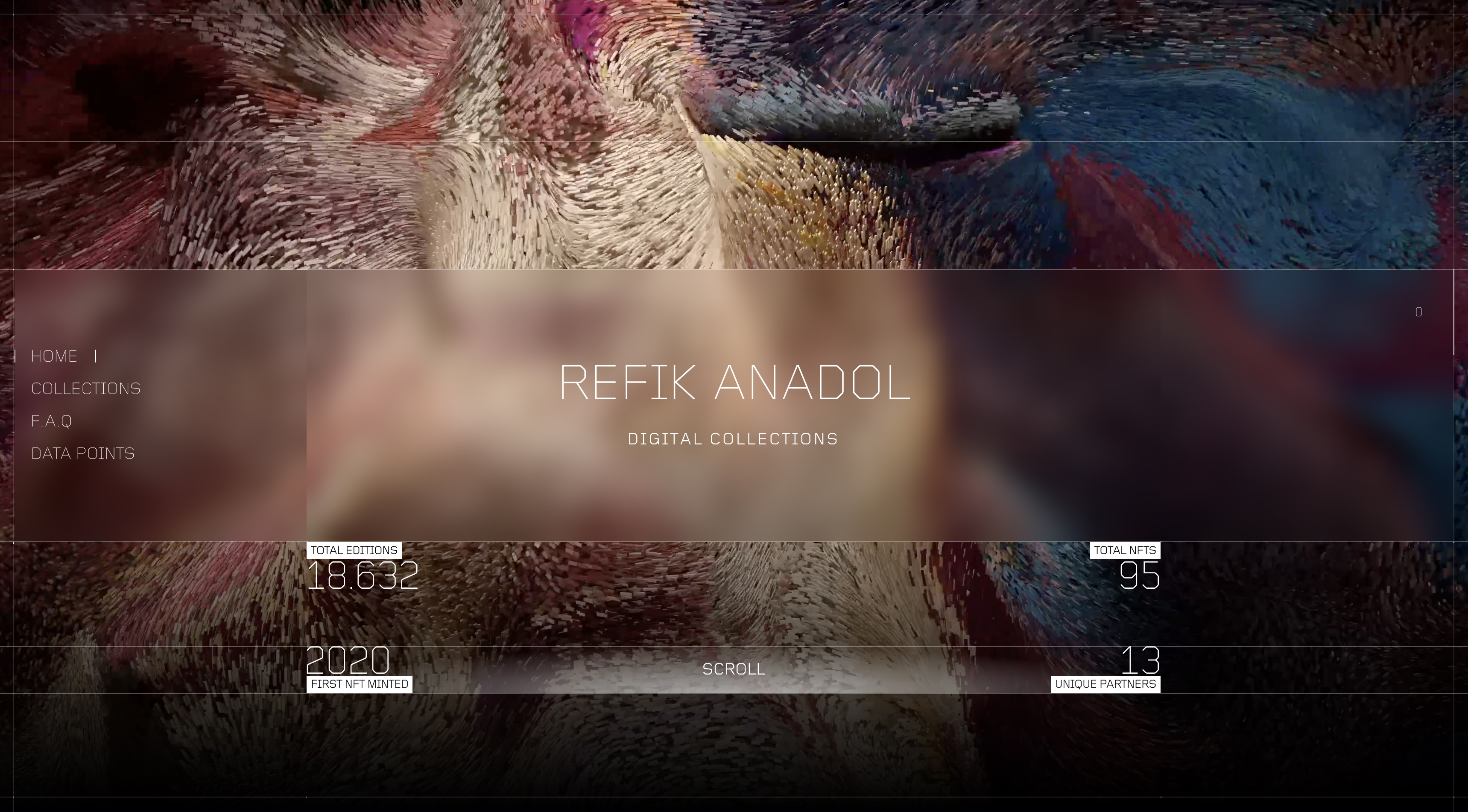
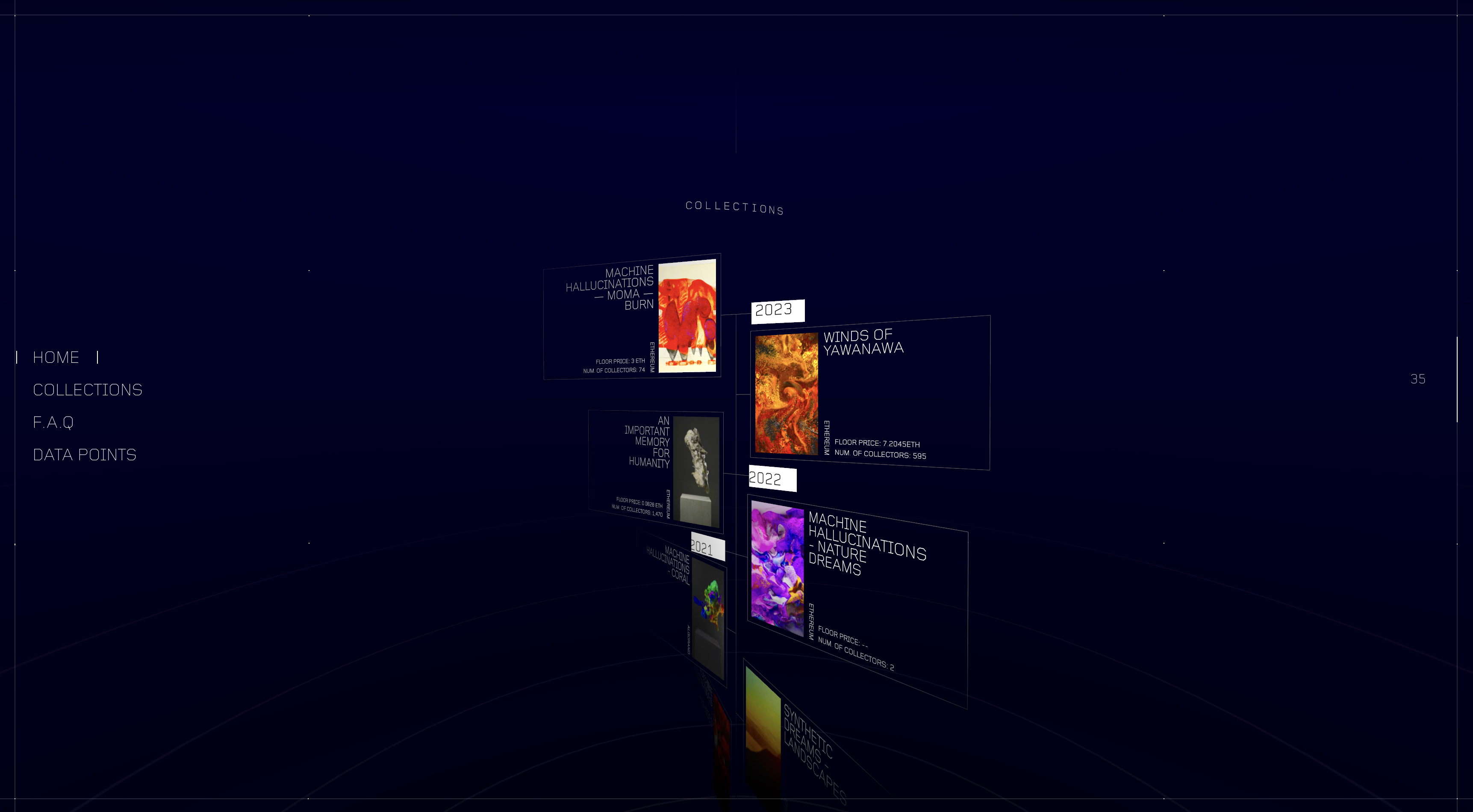
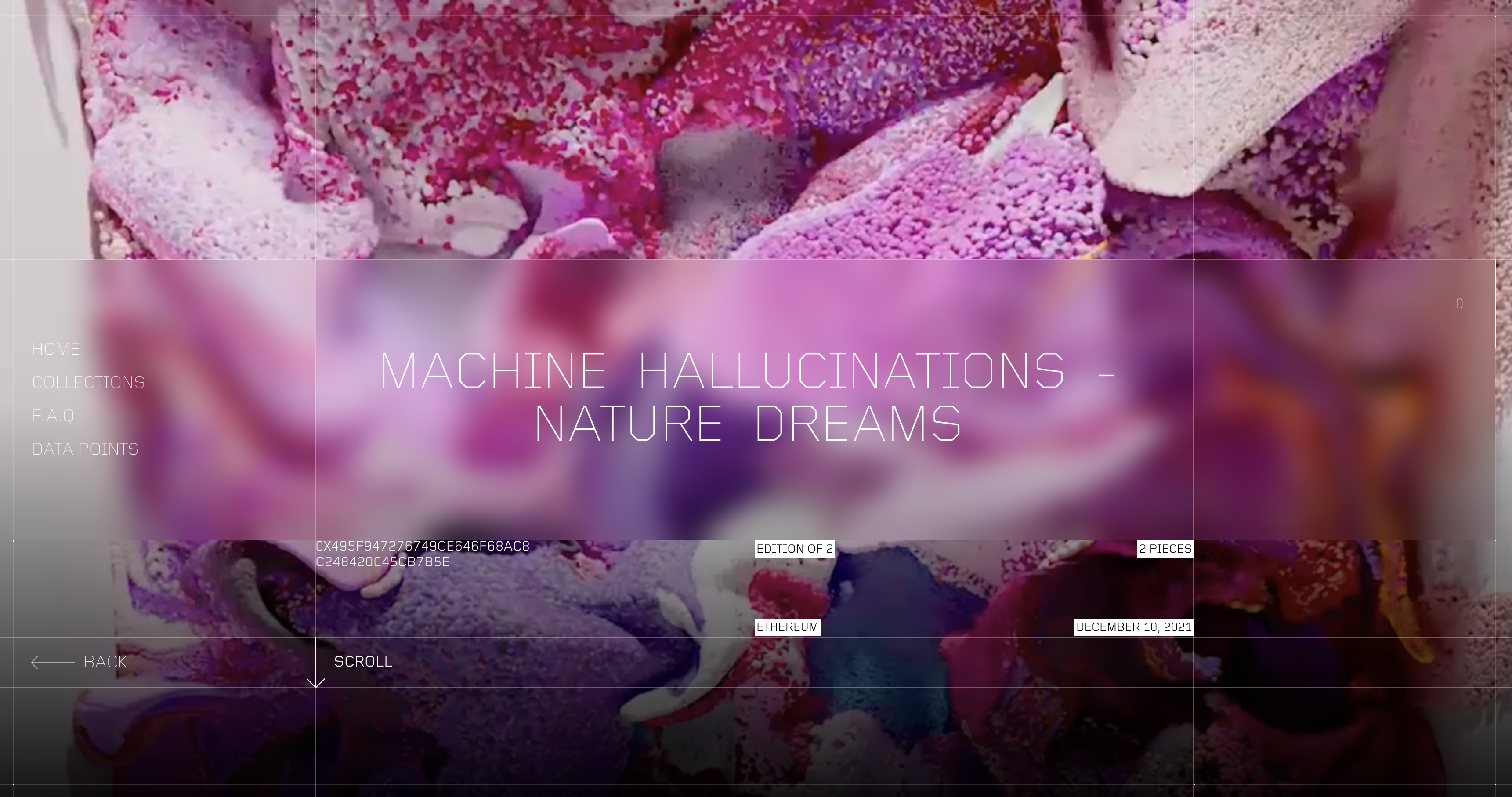
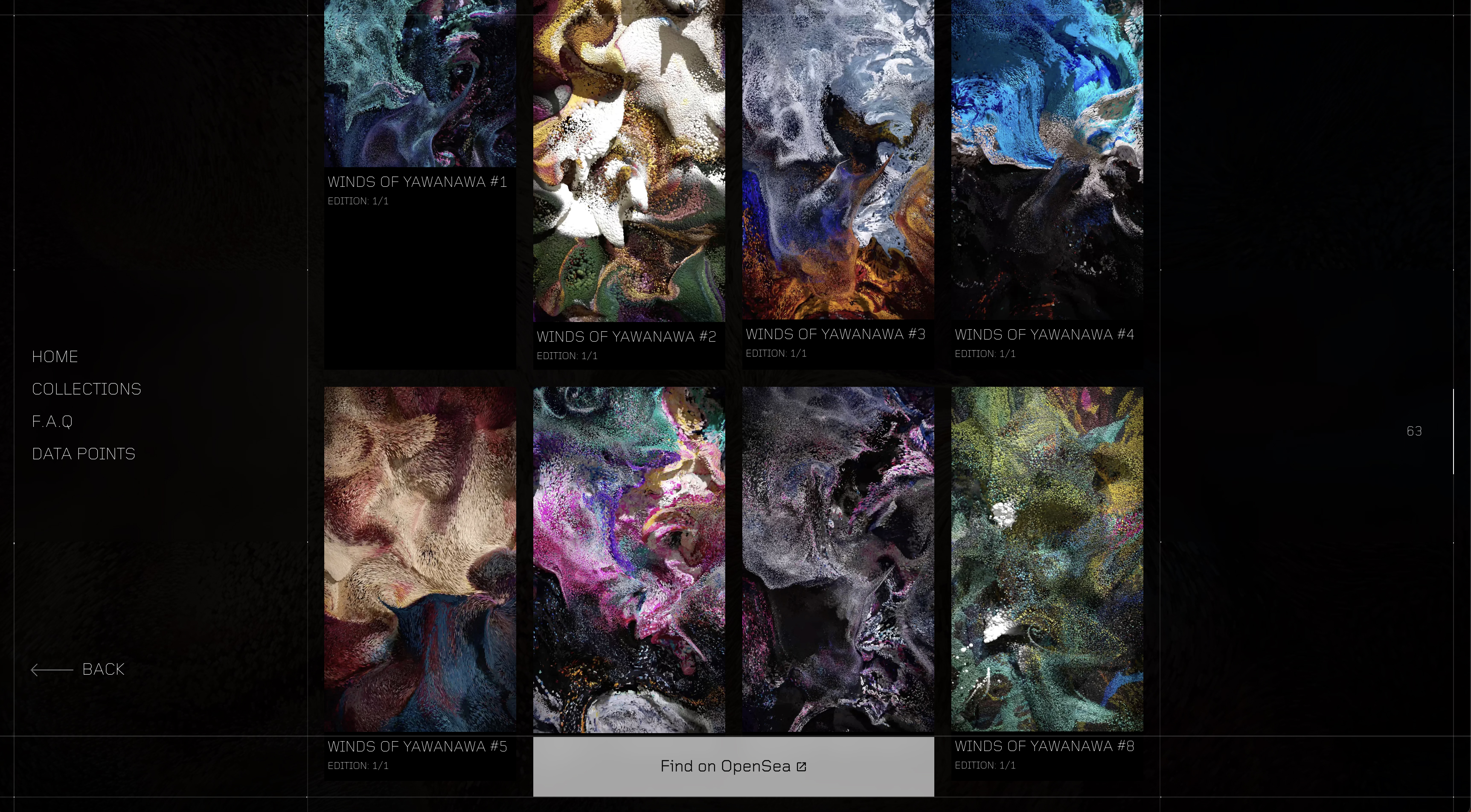
The website provides a central destination for exploring Refik Anadol Studio's NFT work and serves as a flexible platform for future growth. The system supports ongoing updates, new collection launches, and evolving content requirements while maintaining a consistent user experience across devices. The project received an Honorable Mention from Awwwards.
This project demonstrates experience creating visually sophisticated digital platforms where design, engineering, content strategy, and motion design work as a unified system. It showcases the ability to build interfaces containing extensive micro-interactions, animated transitions, and responsive motion behaviours while maintaining clarity, accessibility, and performance.
LOYALTY Arts
2024–Present
LOYALTY is a Wales-based cultural organisation supporting emerging Black artists through mentorship, development programmes, workshops, and professional opportunities. We designed and developed a bespoke digital platform that communicates the organisation's mission while providing a scalable framework for artists, programmes, publications, partnerships, and future growth. The website balances editorial clarity with thoughtful motion design, creating an experience that feels both professional and contemporary.
Developed a clear information architecture focused on discoverability and long-term scalability.
Designed a clean editorial interface that prioritises content while maintaining a distinct visual identity.
Used motion and interaction selectively to support navigation, storytelling, and engagement.
Implemented a flexible content model within Sanity CMS to support future expansion.
Optimised the experience across devices with a mobile-first design and development process.
Built a modern, maintainable architecture focused on performance, accessibility, and ease of management.
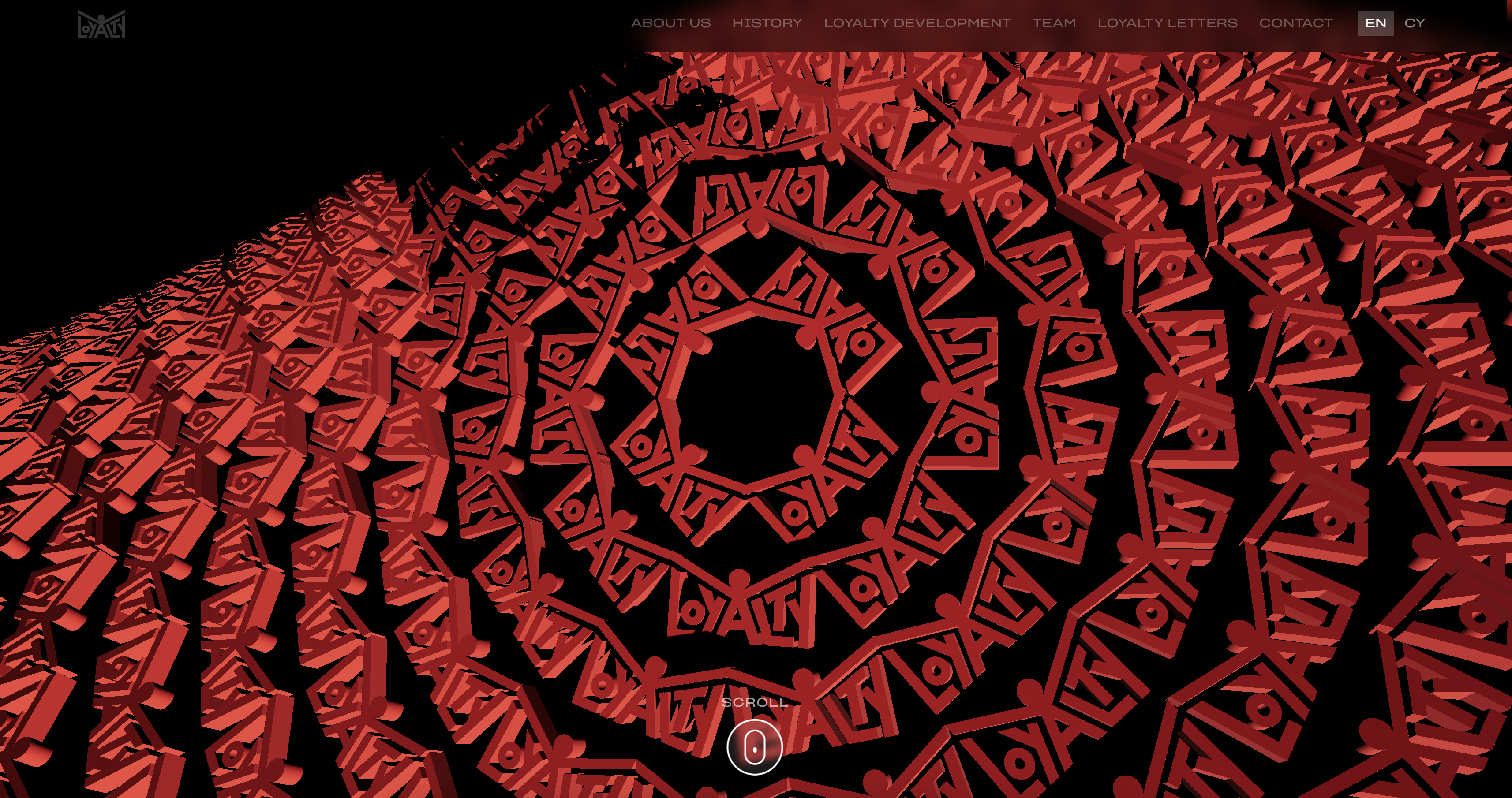
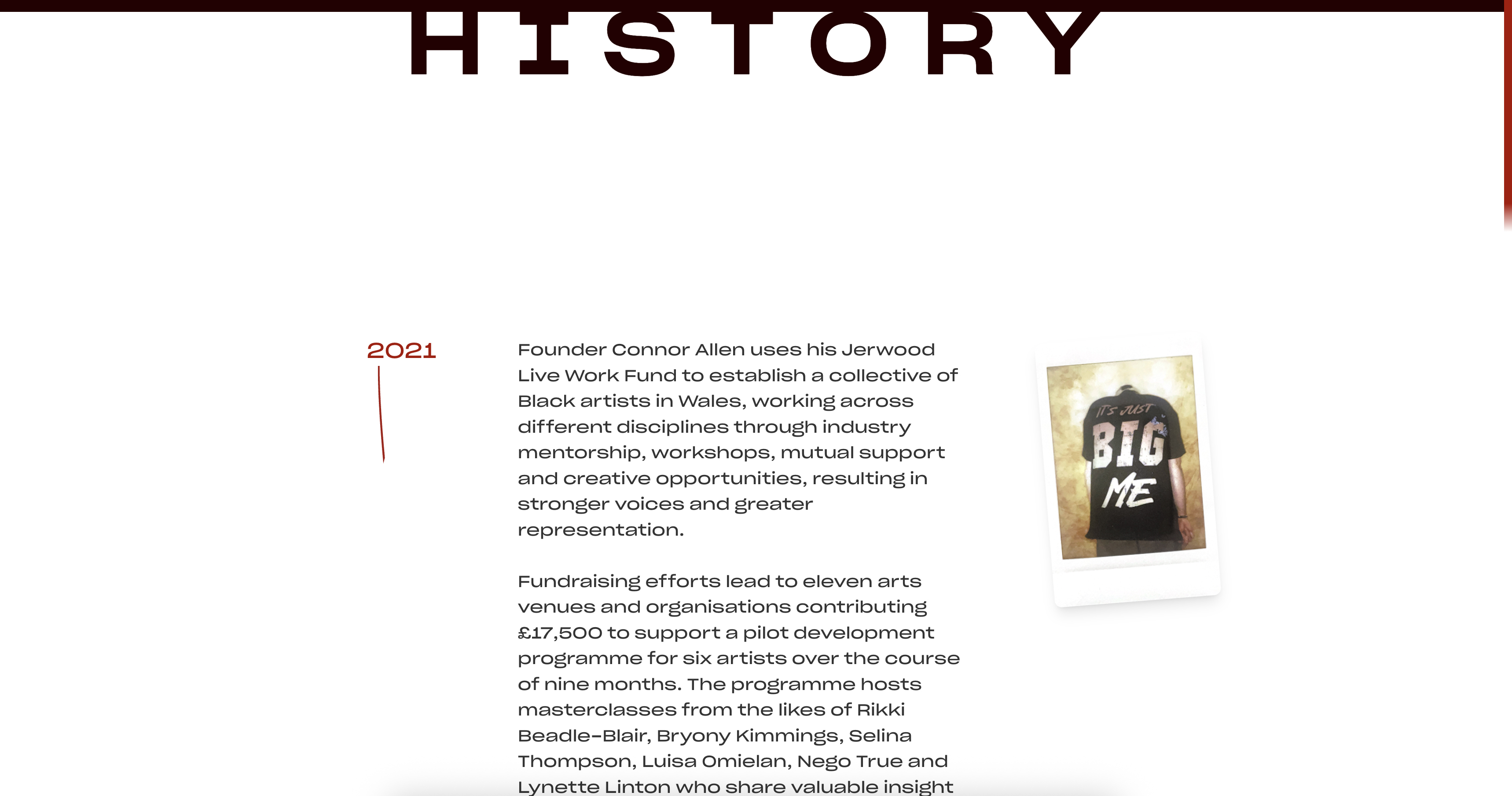
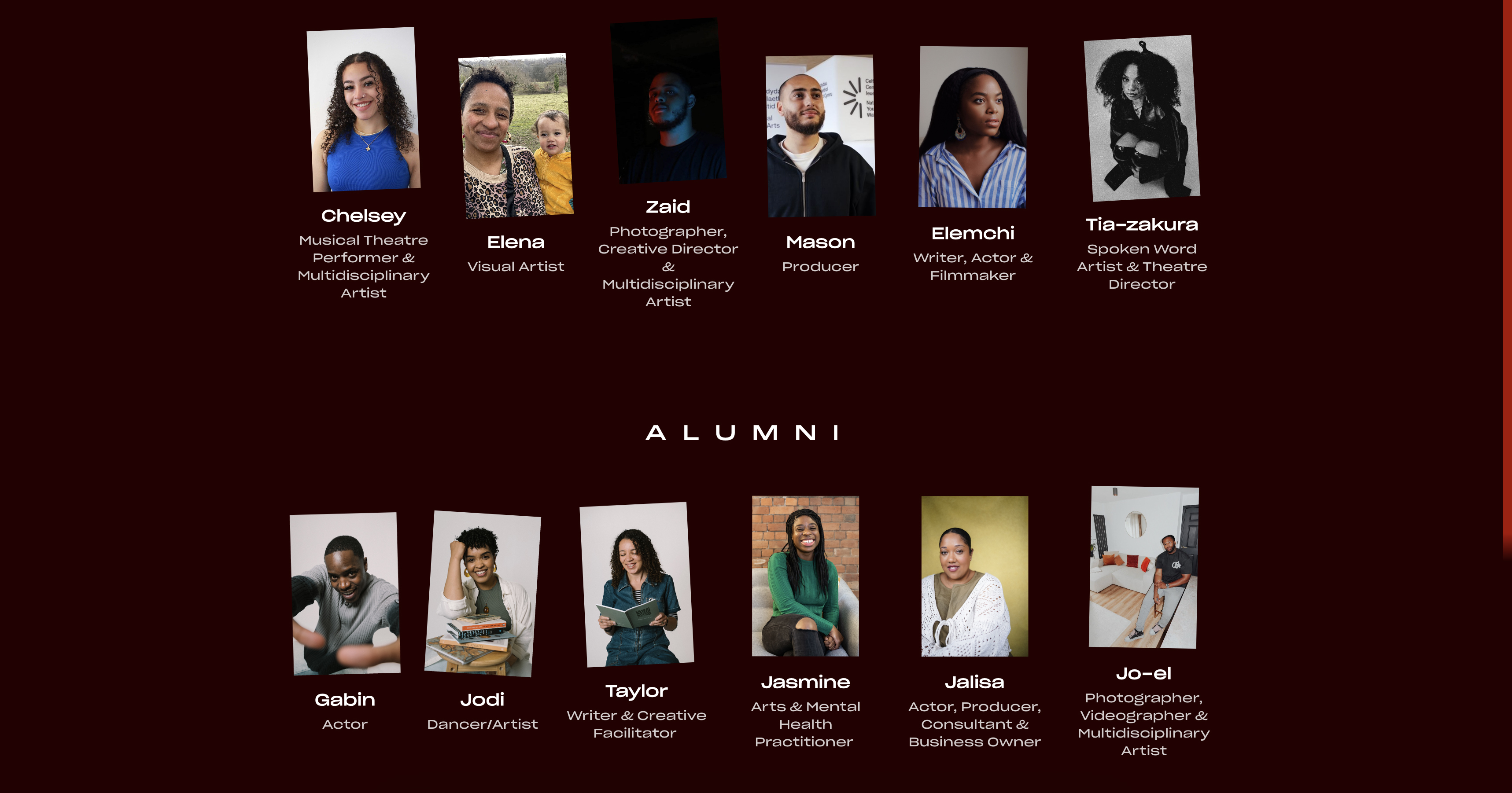
The result is a flexible and scalable digital platform that supports LOYALTY's growing programmes, artist community, and organisational activities. The website provides a fast, highly responsive experience across devices while giving the team complete control over content management. Its structure is designed to accommodate future initiatives without requiring fundamental changes to the platform.
Cultural organisations often evolve rapidly as programmes, partnerships, and communities grow. This project demonstrates our ability to create long-term digital systems that remain clear, maintainable, and adaptable while supporting ambitious cultural missions. It combines strategy, design, engineering, and ongoing collaboration to create a platform capable of growing alongside the organisation it represents.
RD Rentals
2024–2026
RD Rentals was a dedicated equipment rental platform created for RD Rentals, a specialist rental business operated by RD Content. Building on an ongoing relationship that has included multiple projects for the wider organisation, we designed and developed a bespoke rental website that combined a polished customer experience with the operational capabilities of the client's existing rental management system.
Designed a bespoke user interface tailored to the needs of equipment rental customers.
Built the website on Squarespace to provide a familiar and accessible content management environment.
Used Booqable as the underlying inventory and booking database rather than developing a custom rental platform.
Developed custom JavaScript and CSS components hosted on Vercel to extend the capabilities of Squarespace.
Created responsive layouts and booking journeys optimised for both desktop and mobile users.
Focused on clarity, usability, and trust throughout the rental experience.
The resulting platform combined the simplicity of Squarespace with the specialised rental functionality of Booqable, delivering a streamlined customer experience without requiring a fully custom rental system. The website successfully supported RD Rentals' operations between 2024 and 2026 while providing a scalable and maintainable digital presence.
This project demonstrates how existing platforms and third-party services can be combined into a cohesive digital product without the cost and complexity of building a fully custom solution. Through careful design, custom front-end development, and strategic integration work, it was possible to create a rental experience that felt bespoke while leveraging proven operational tools already used by the business.
Refik Anadol
2023–Present
A bespoke link hub created for artist and designer Refik Anadol. Designed as an alternative to generic link-in-bio platforms, the microsite provides a central destination for exhibitions, projects, publications, social channels, press coverage, and other key resources. The platform includes a custom-built administration system that allows content to be updated quickly and independently while maintaining complete control over branding, presentation, and user experience.
Designed a bespoke user experience tailored specifically to Refik Anadol's needs.
Developed a custom administration panel for managing links, categories, and featured content.
Focused on simplicity, speed, and ease of navigation across all devices.
Used animation and interaction selectively to enhance the experience without introducing unnecessary complexity.
Hosted the platform on scalable cloud infrastructure for reliability and long-term maintenance.
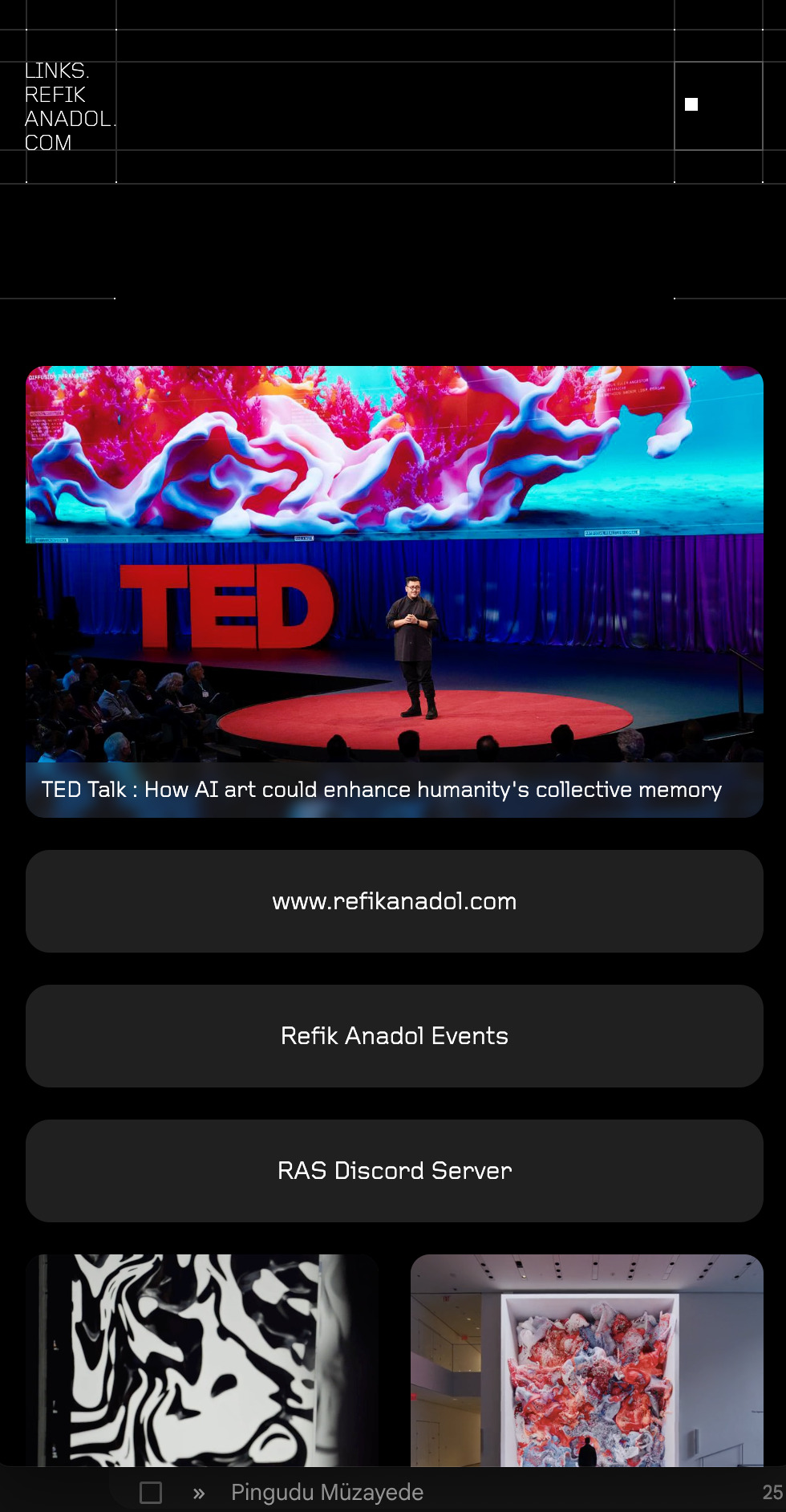
The result is a lightweight and fully customised link platform that provides complete control over content, branding, and presentation. The custom administration system allows updates to be made quickly while maintaining consistency across the experience. Since launch, the platform has served as a central gateway connecting audiences to exhibitions, projects, publications, and digital platforms across Refik Anadol's growing body of work.
Most link-in-bio services prioritise convenience over flexibility. This project demonstrates how a relatively simple utility can become a valuable branded product when custom design, engineering, and content management are considered together. By replacing a generic third-party solution with a bespoke platform, the project delivers greater control, stronger branding, and a significantly better user experience.
Refik Anadol
2022–Present
A custom-built online presentation platform developed for Refik Anadol Studio to replace the workflow of sending extremely large presentation files. Instead of distributing downloadable presentations exceeding 300MB, the studio shares browser-based presentation experiences through dedicated URLs. The platform replicates the structure, pacing, and behaviour of native presentation software while functioning as a lightweight and accessible web application.
Designed a custom browser-based presentation system instead of using downloadable files
Created slide-based navigation and transitions inspired by native presentation software
Focused on clarity, pacing, and presentation readability
Integrated motion design and interaction systems using GSAP
Built a flexible CMS structure allowing presentation content to be updated dynamically
The platform transformed how presentations were shared across the studio. Instead of distributing large downloadable files, the studio could send lightweight URLs that opened immersive browser-based presentations. The system improved accessibility, reduced friction in communication workflows, and allowed presentation content to evolve dynamically without requiring new file exports or uploads.
The project demonstrates how design and engineering can solve operational problems through custom digital systems rather than relying on existing software limitations. By transforming presentations into web experiences, the platform merged workflow optimisation, motion design, interface design, and engineering into a single scalable tool tailored specifically for a fast-moving creative studio.
Refik Anadol
2022–Present
The second major iteration of Refik Anadol’s official website. The project involved redesigning and rebuilding the existing WordPress platform to better represent the growing scale of the studio’s work, exhibitions, research, and public presence. The new version introduced a clearer information architecture, a more refined visual language, and a flexible content management system capable of supporting frequent updates across projects, exhibitions, news, and publications.
Redesigned the information architecture around the studio’s evolving needs
Developed a cleaner and more structured user experience
Created reusable design and content patterns throughout the site
Integrated subtle and large-scale GSAP animations to improve navigation and engagement
Built a flexible WordPress backend allowing editors to manage content independently
Optimised layouts and interactions for desktop, tablet, and mobile devices
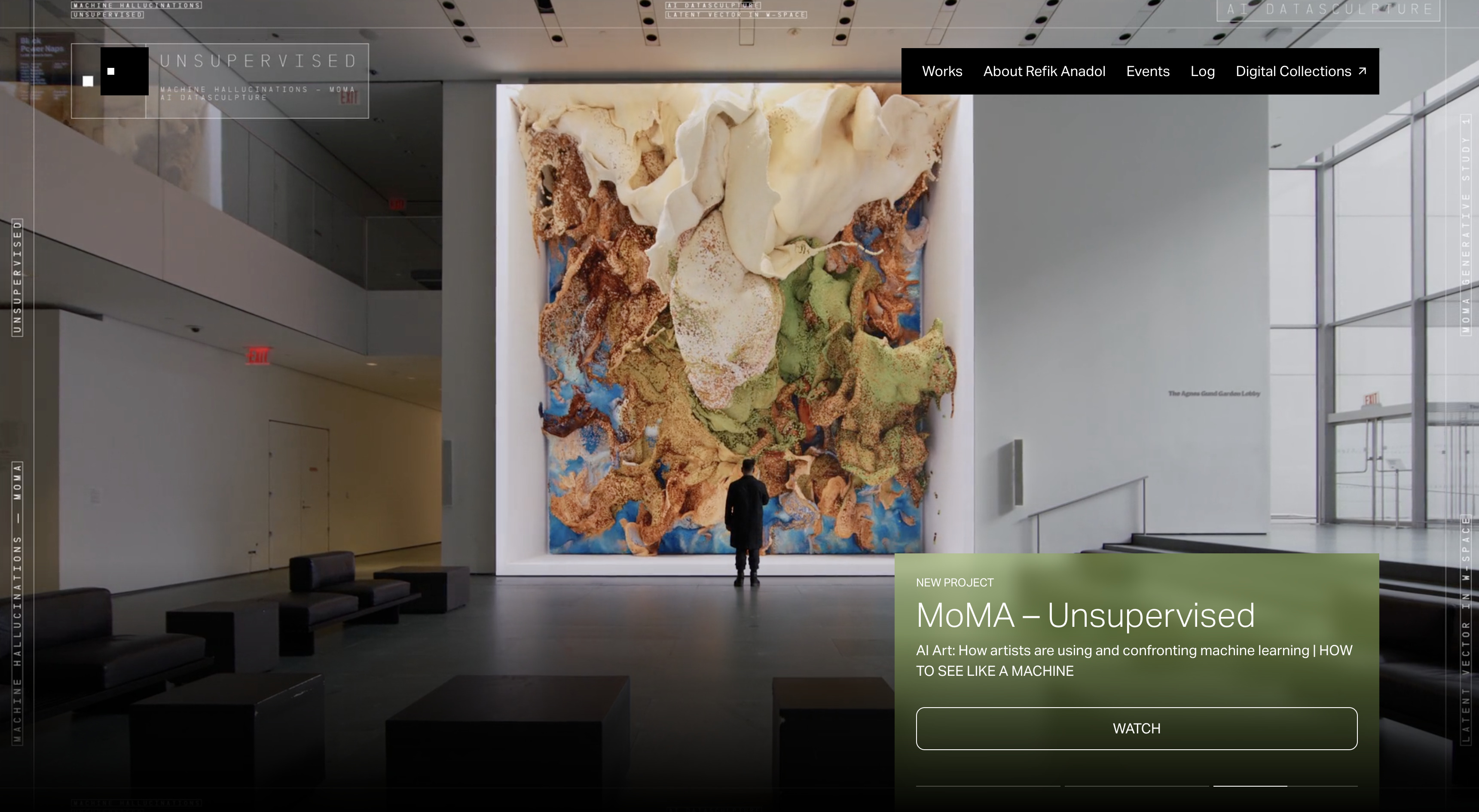
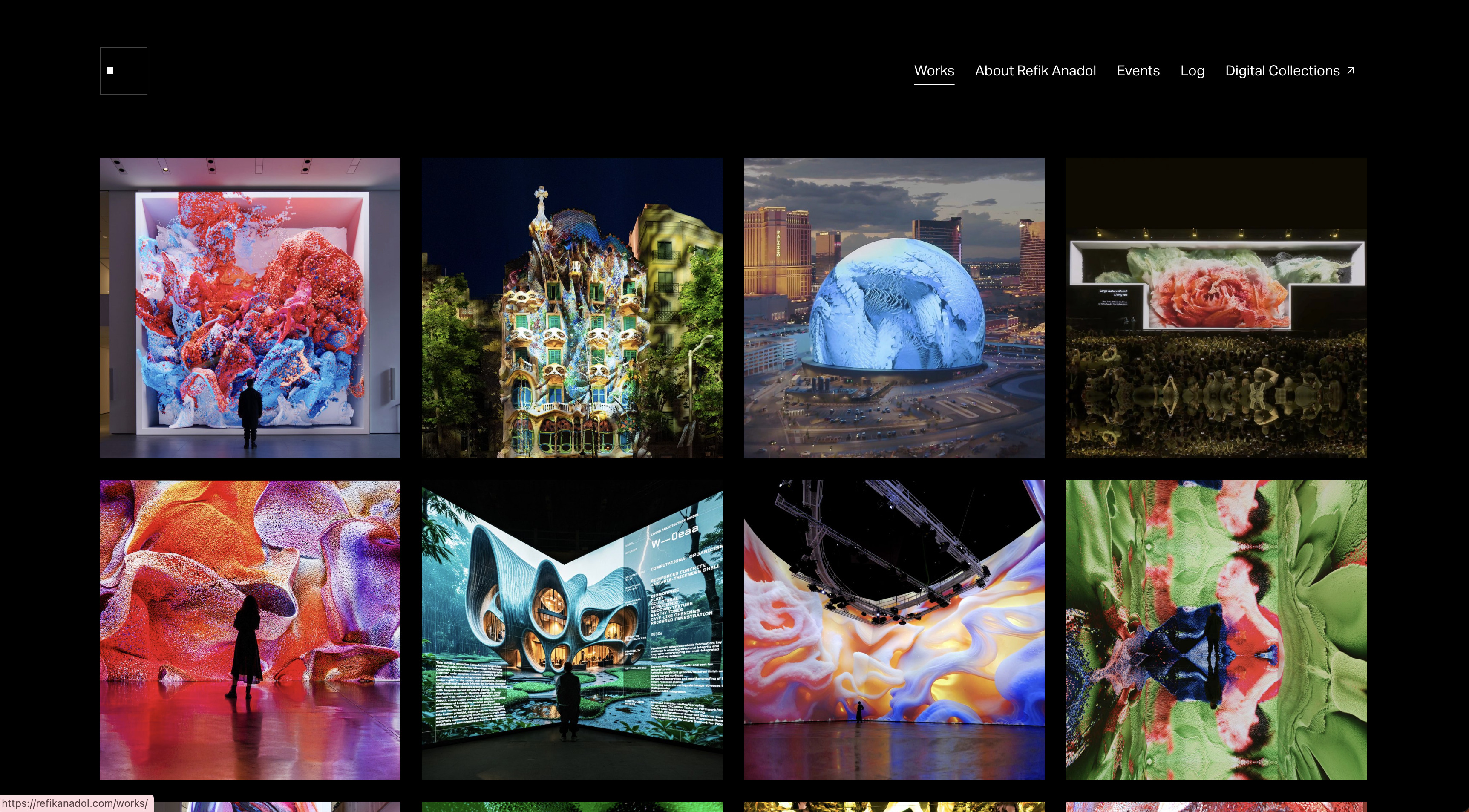
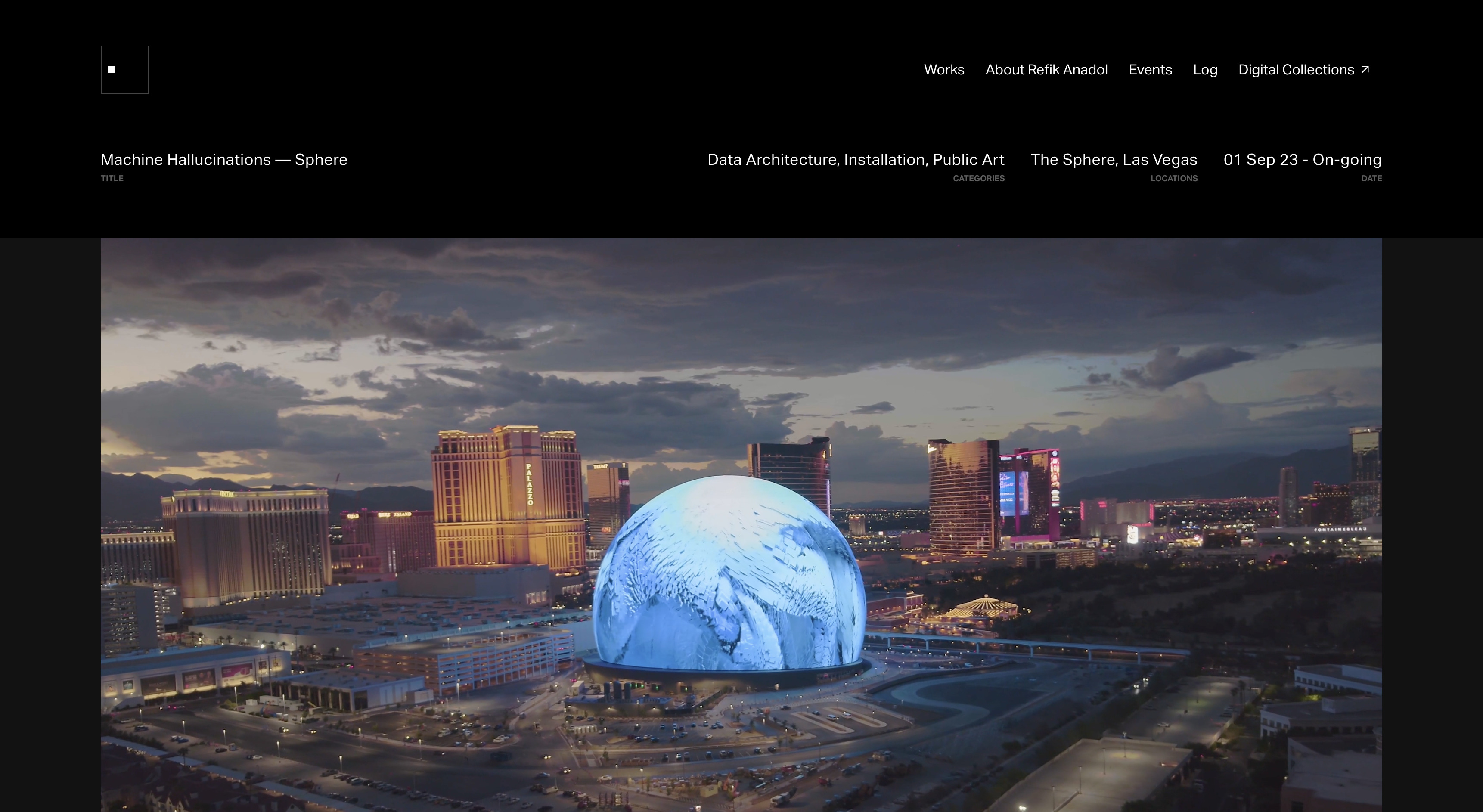
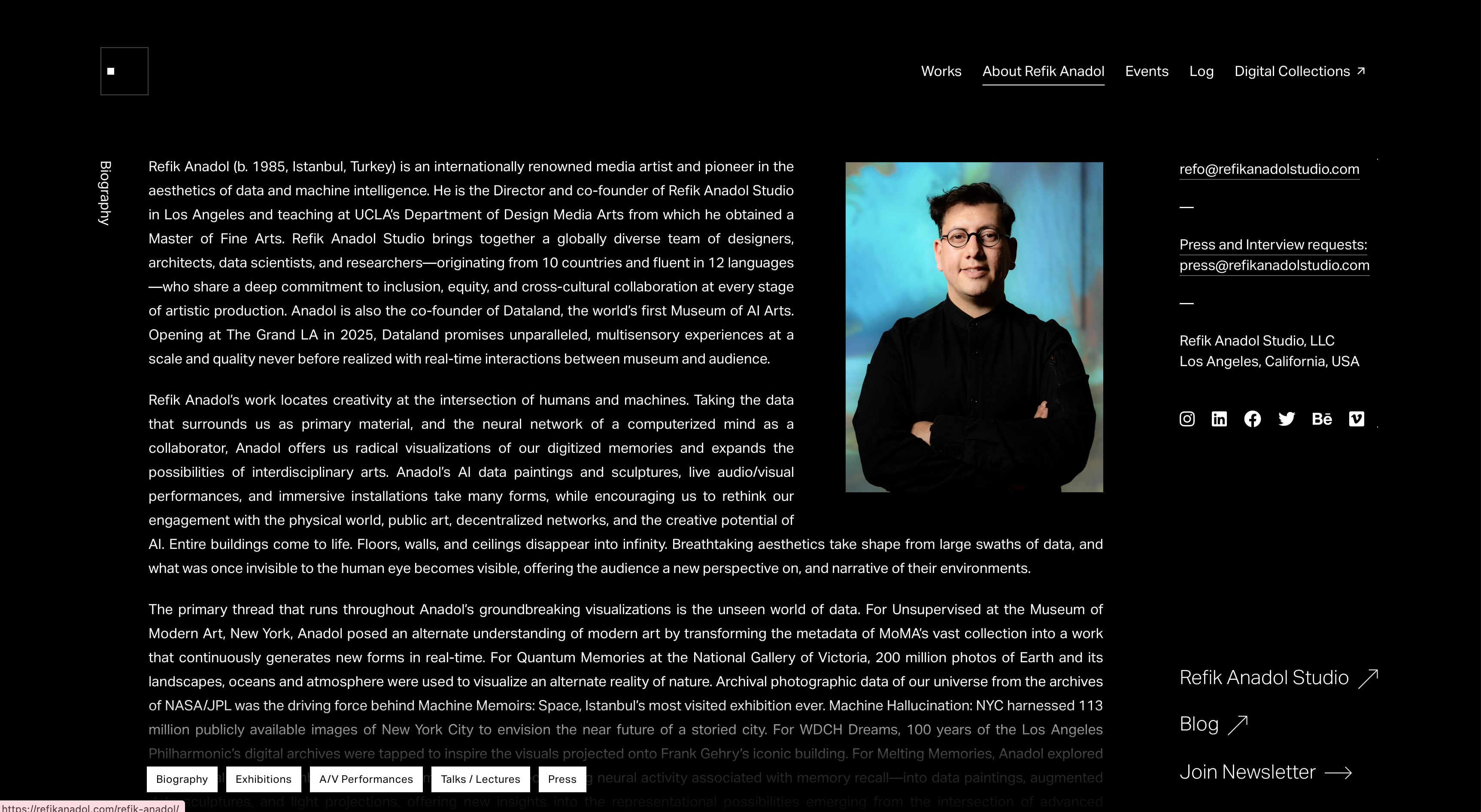
The redesigned platform provided a clearer and more scalable foundation for presenting Refik Anadol’s growing portfolio of artworks, exhibitions, and research initiatives. The improved structure simplified content management while creating a more engaging experience for visitors through thoughtful motion design and refined navigation.
This project marked an important evolution of the studio’s digital presence. As the scale and visibility of Refik Anadol’s work expanded internationally, the website needed to evolve from a portfolio into a comprehensive platform capable of supporting exhibitions, research, publications, and ongoing studio activity. The project demonstrates how design systems, content structure, and motion design can work together to support a growing cultural organisation.
Refik Anadol
2022–Present
A dedicated events platform designed to organise and present Refik Anadol’s growing programme of exhibitions, talks, installations, screenings, and public appearances. As the volume of events increased globally, locating past, current, and upcoming activities within the main website became increasingly difficult. The project introduced a dedicated microsite that aggregates event data from the main Refik Anadol website and presents it through a fast, searchable, and filterable interface.
Proposed a dedicated events-focused microsite separate from the main website experience
Connected the platform directly to the existing WordPress content structure
Built a custom Next.js application that automatically consumes event data from the primary website
Designed a filtering system for browsing events by category and status
Applied motion design and transitions using GSAP to create a polished user experience
Hosted the application on Google Cloud infrastructure for reliability and scalability
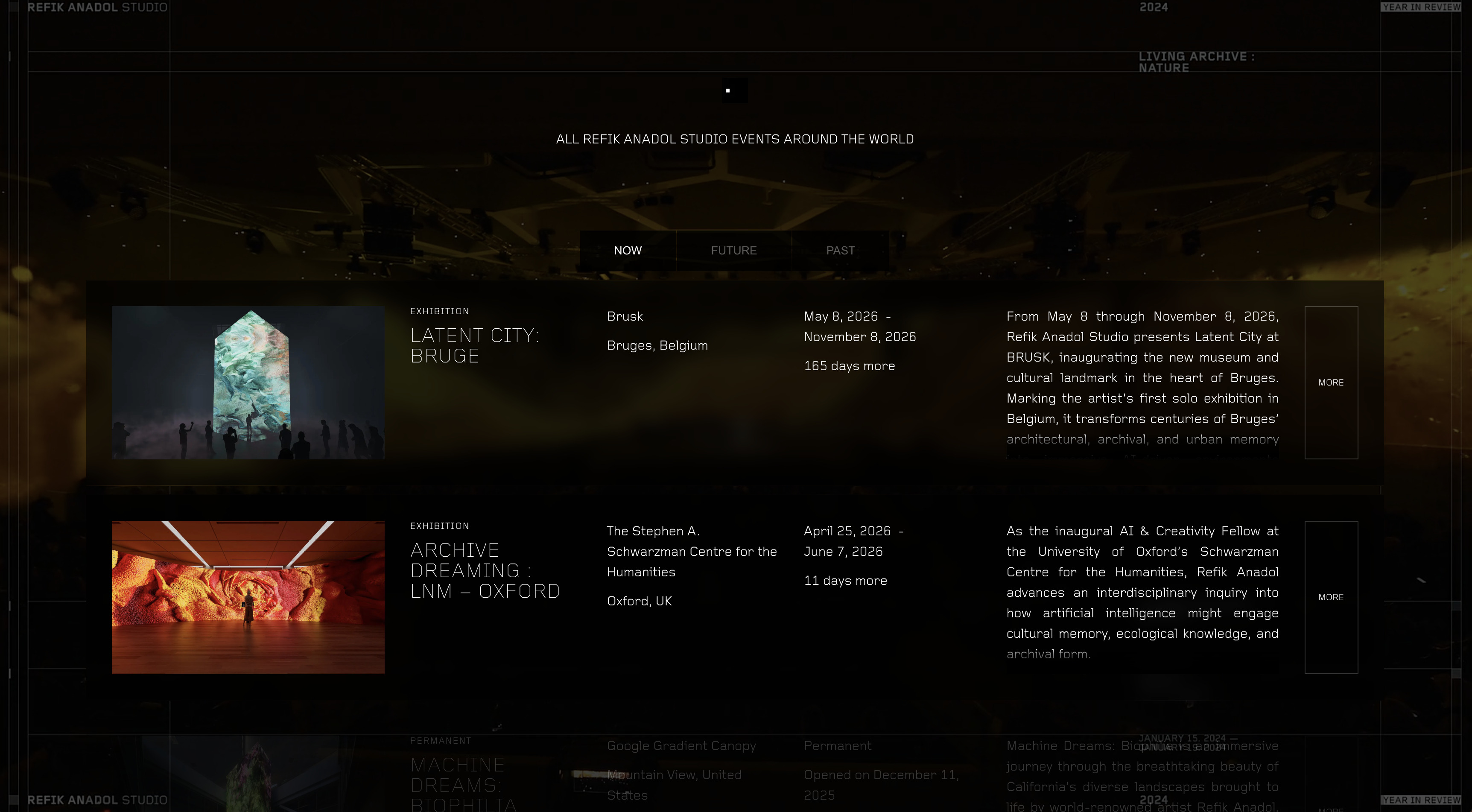
The platform established a dedicated archive and discovery tool for Refik Anadol’s global event programme. Visitors can quickly explore upcoming exhibitions, historical events, and public appearances through a streamlined interface, while content editors continue managing information from a single WordPress source without additional publishing workflows.
This project demonstrates how a focused digital product can emerge from an existing content ecosystem. Rather than expanding the complexity of the main website, the solution created a specialised platform tailored to a specific user need while remaining fully connected to the studio’s existing publishing infrastructure. It highlights expertise in product thinking, content architecture, API-driven development, and the integration of WordPress with modern frontend technologies.
Refik Anadol
2021–2025
A dedicated website created to showcase Refik Anadol’s NFT works during the rapid emergence of digital collectibles and blockchain-based art. Rather than functioning as a marketplace, the platform served as a curated portfolio and information hub for NFT releases, collections, exhibitions, and project narratives. The experience combined strong visual presentation, custom animations, and detailed project pages to communicate the artistic and technical depth behind each work.
Designed a visually immersive interface centred around the artworks
Created a custom design system tailored specifically for NFT projects
Used animation and micro-interactions to guide navigation and create visual continuity
Developed flexible content structures for collections, individual works, and project information
Built reusable WordPress components to support ongoing updates and future releases
Focused on storytelling and presentation rather than transactional marketplace functionality
The platform became the primary destination for presenting Refik Anadol’s NFT body of work between 2021 and 2025. It supported multiple collection launches and provided collectors, curators, and audiences with a visually rich environment for exploring projects and their narratives. In 2025 the website was replaced by a new generation platform built to accommodate the expanding scale and complexity of the NFT programme.
The project captures an important moment in the evolution of digital art and NFTs. It demonstrates the ability to translate complex artistic concepts into an engaging online experience through motion design, interaction design, and structured storytelling. The website also highlights long-term collaboration, evolving alongside the studio’s NFT activities over a four-year period before being succeeded by a more advanced platform.
Jukebox Collective
2021–Present
Design and development of the official website for Jukebox Collective, an award-winning creative organisation supporting young people through dance, music, theatre, and creative education. The project began with extensive information architecture planning and interactive UX mapping in Figma, followed by detailed design prototyping and custom WordPress development. The resulting platform combines dynamic layouts, motion design, and flexible content management to reflect the organisation’s energy while supporting a wide range of programmes, projects, events, and community initiatives.
Mapped the entire user experience and content structure in Figma before visual design began
Created an interactive UX prototype to test navigation paths, page relationships, and content hierarchy
Designed a flexible visual system capable of supporting diverse content including programmes, projects, news, events, and educational initiatives
Produced an interactive design prototype to validate layouts, interactions, and user flows before development
Developed dynamic page compositions that introduce variation while maintaining consistency across the platform
Integrated micro-animations and subtle motion design to enhance navigation and engagement
Built a custom WordPress platform with reusable content components and editorial flexibility
Provided ongoing maintenance, hosting, and continuous improvements following launch
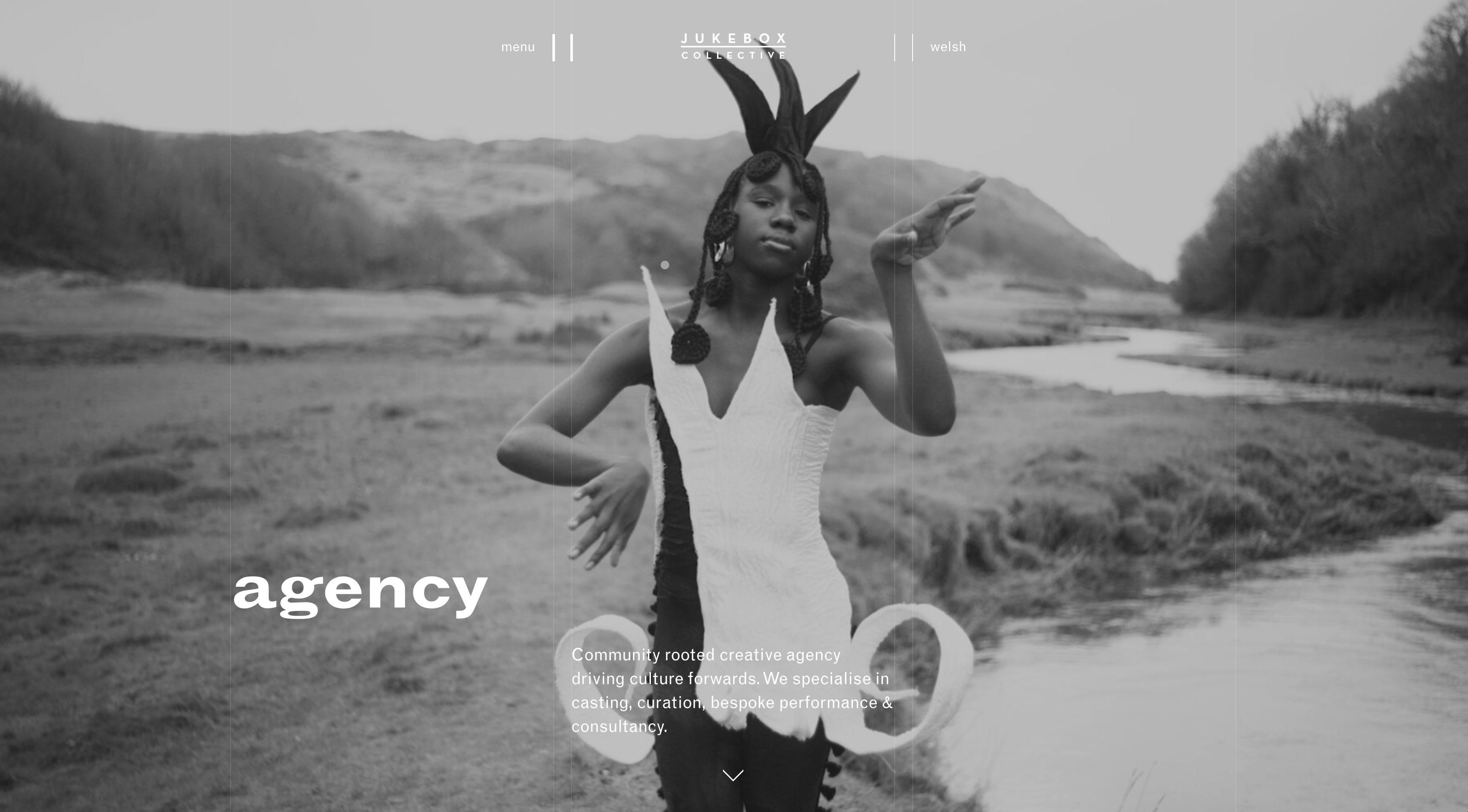
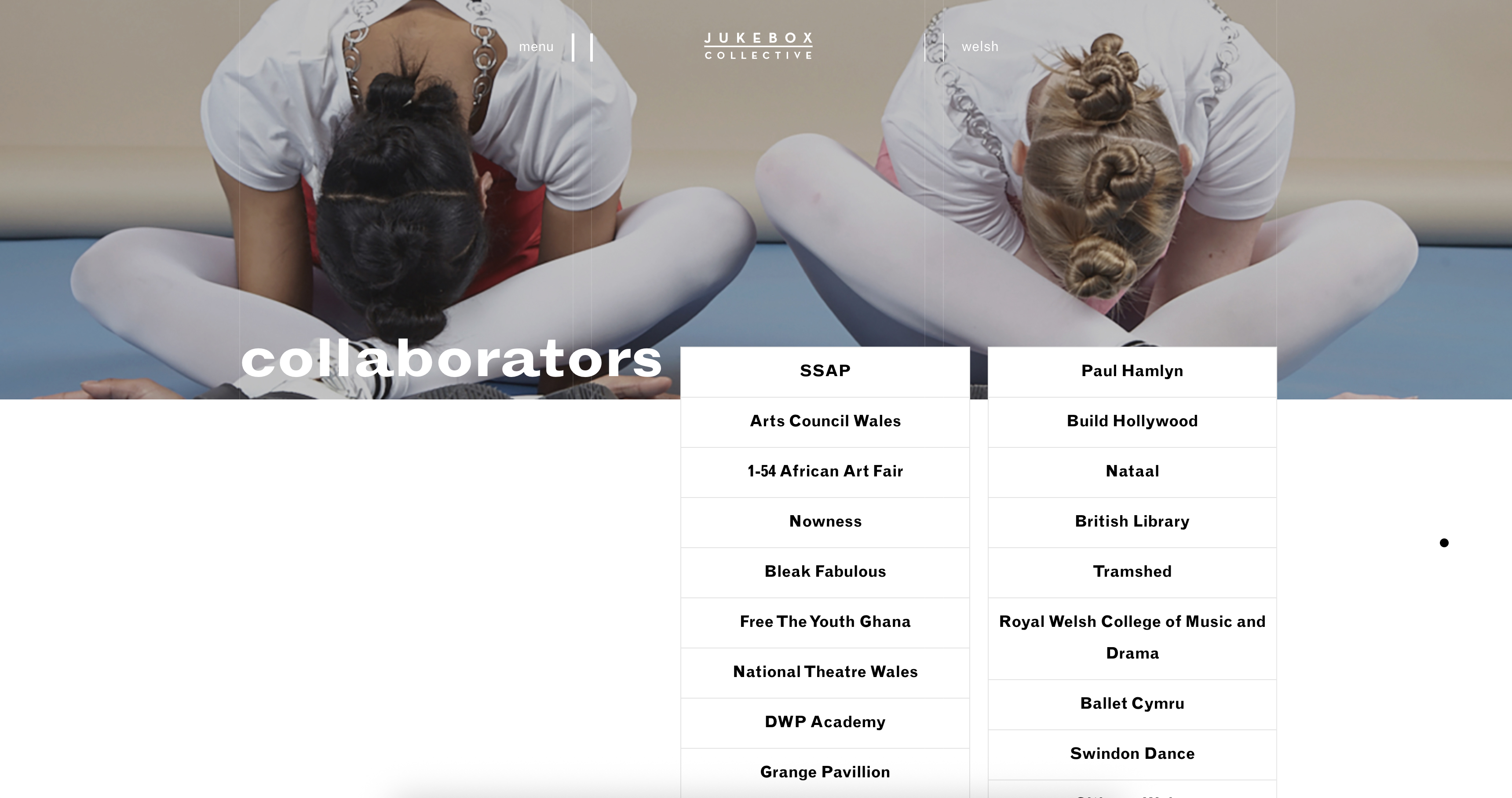
The website provides Jukebox Collective with a flexible and engaging platform for communicating its mission, programmes, achievements, and community impact. Through a combination of dynamic layouts, thoughtful interactions, and an adaptable content management system, the platform continues to support the organisation’s evolving activities and audiences.
Jukebox Collective operates across education, performance, community programmes, artist development, cultural projects, and commercial creative work. Creating a digital platform capable of presenting this breadth of activity required careful information architecture as much as visual design. The project demonstrates a process that combines strategy, UX mapping, prototyping, design, and development into a single workflow. From the initial interactive UX maps through to the final WordPress implementation, the focus was on creating a platform that could evolve alongside the organisation while remaining engaging, flexible, and easy to manage.
Can Usta
2020–2023
A minimal online shop created for selling original artworks, prints, and art-related products by artist and designer Can Usta. The website was designed and developed as a lightweight Shopify experience focused on clarity, calm presentation, and reducing visual noise around the artworks themselves.
Used Shopify as the commerce infrastructure while heavily customising the front-end experience
Focused on typography, spacing, and restrained layouts to keep attention on the artworks
Added custom CSS and JavaScript to reshape the default Shopify behaviour and interface
Designed the experience to feel closer to a minimal portfolio website than a traditional online shop
The platform provided a clean and focused environment for presenting and selling artworks online while maintaining a strong artistic identity. The customisations allowed the website to move beyond standard Shopify aesthetics and function more as a curated digital exhibition space combined with an online shop.
The project demonstrates how commercial platforms like Shopify can be adapted into more restrained and artistically driven digital experiences through custom design and engineering decisions. Instead of relying on heavy marketplace aesthetics, the platform prioritised atmosphere, clarity, and presentation.
Wiselang
2020–Present
Design and development of an immersive portfolio website for Wise Slang, built around a custom WebGL particle environment that forms the foundation of the entire user experience. Rather than treating animation as a decorative layer, the site uses a continuously evolving particle system as its primary visual language. The environment responds to navigation, transforms between sections, and remains fully interactive across desktop and mobile devices while showcasing the agency’s work, services, and capabilities.
Designed the experience around a custom particle simulation rather than conventional page layouts
Developed section-specific animation states that transform the environment as users navigate through the site
Created interactive behaviours that respond to user movement and scrolling
Carefully optimised rendering performance for both desktop and mobile devices
Integrated the custom frontend with WordPress to allow flexible content management
Implemented motion design and transitions that connect content sections through a unified visual system
Provided ongoing maintenance, hosting, and technical support following launch
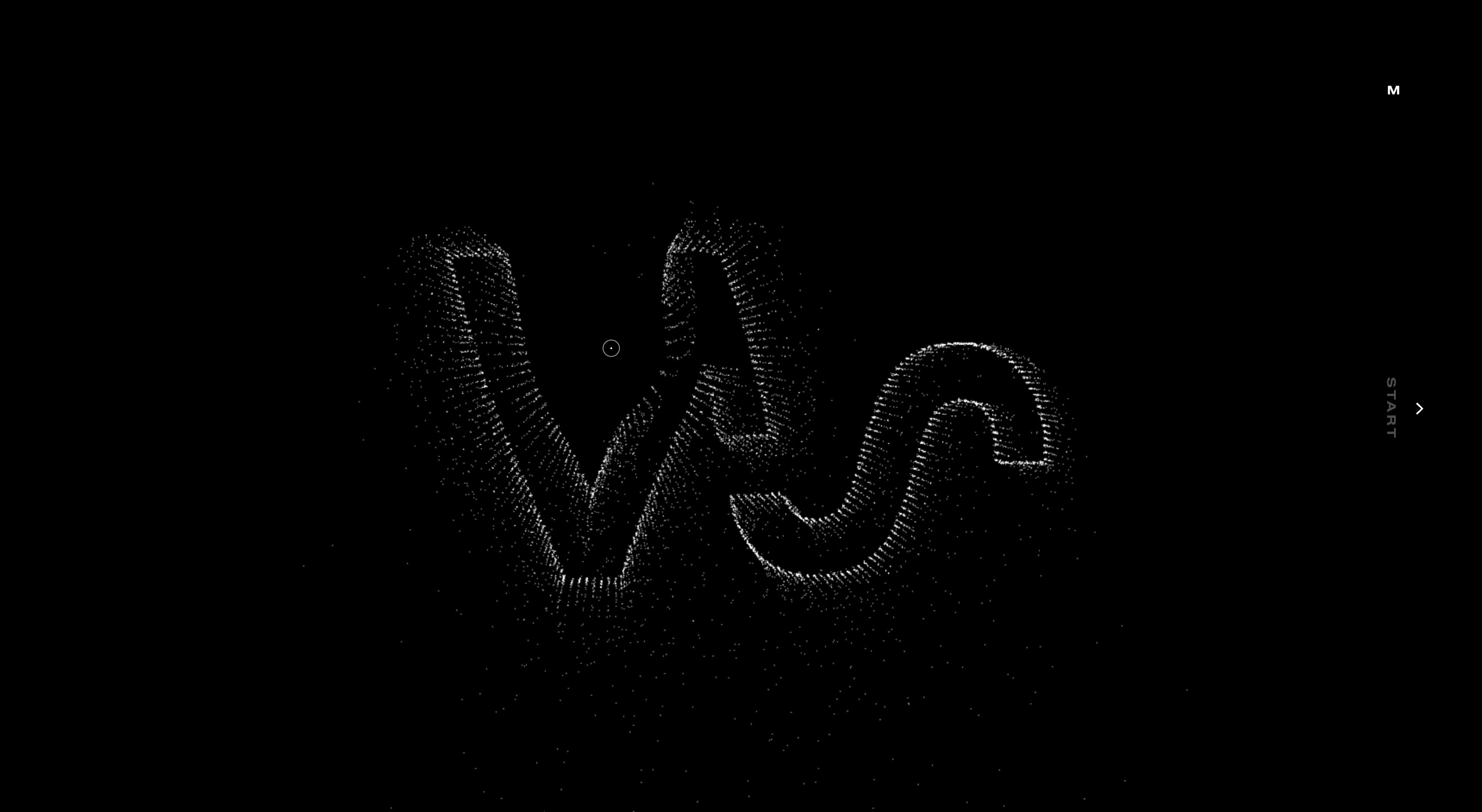
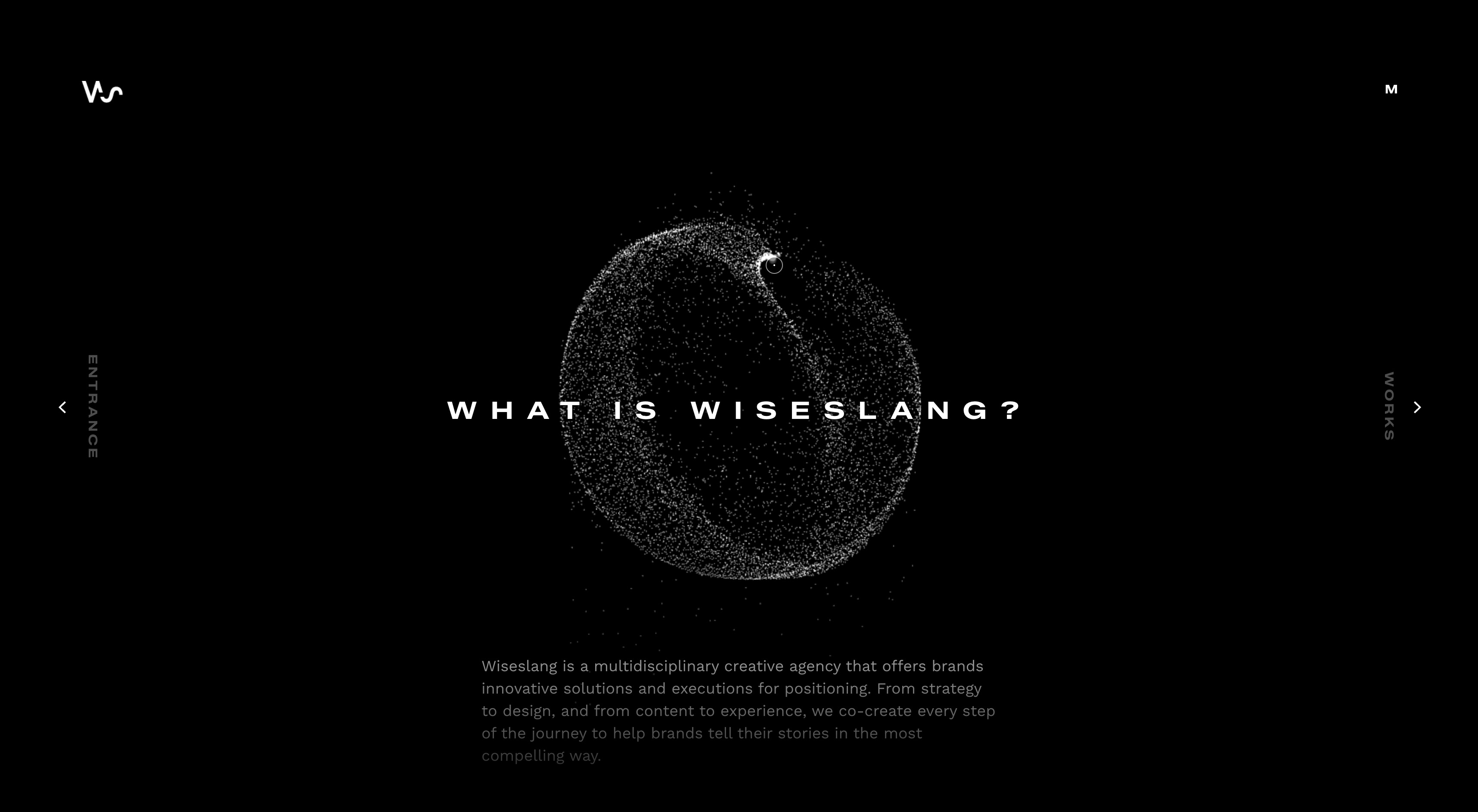
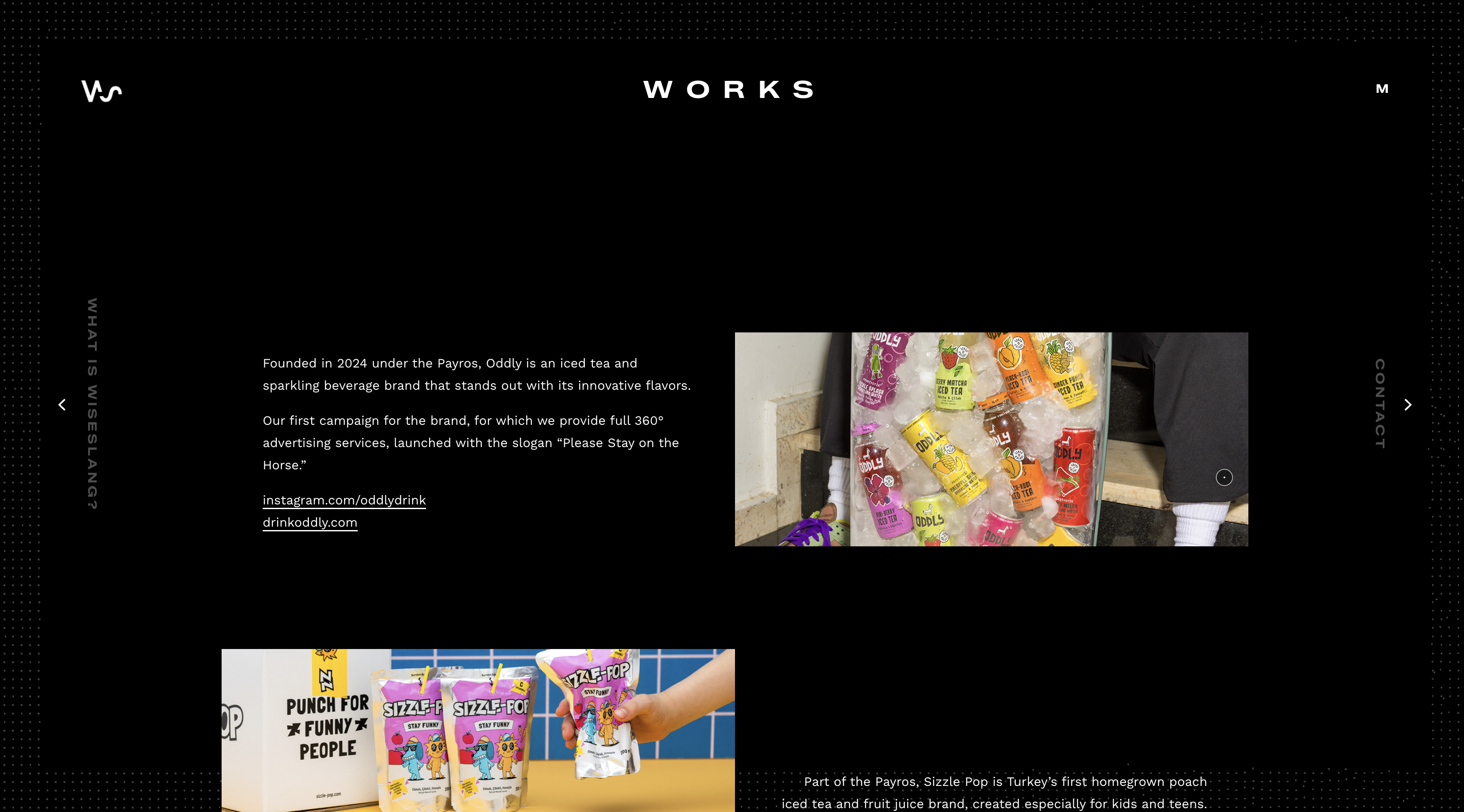
The website established a distinctive digital presence for Wise Slang through a highly interactive visual experience that combines content, motion, and real-time graphics. The project received an Honorable Mention from Awwwards, recognising the quality of its design, creativity, and execution. The platform continues to support the agency’s portfolio and business development activities through ongoing maintenance and updates.
This project demonstrates the integration of design, engineering, and motion into a single digital experience. The WebGL particle environment is not a standalone feature but the structural foundation of the website itself, influencing navigation, storytelling, and interaction throughout the platform. Successfully delivering the same immersive experience across desktop and mobile devices required significant attention to performance, optimisation, and technical architecture. The resulting project showcases expertise in creative development, real-time graphics, interaction design, and long-term platform support.
Refik Anadol Studio
2020–Present
Design and development of the official website for Refik Anadol Studio, presenting the studio’s multidisciplinary work across artificial intelligence, data sculpture, immersive installations, architecture, research, and cultural projects. The platform was designed to reflect the experimental nature of the studio through a dynamic visual system where layouts continuously reconfigure themselves, creating a slightly different experience on every visit while maintaining clarity and usability.
Designed a custom visual system inspired by the studio’s approach to generative systems and data-driven processes
Developed dynamic layout logic that changes the position, scale, and arrangement of elements on each page load
Created a large collection of micro-interactions and motion behaviours throughout the interface
Used GSAP to choreograph transitions, hover states, navigation behaviour, and content reveals
Built a completely custom WordPress theme from scratch without relying on third-party themes or builders
Developed reusable content modules to support editorial flexibility and future growth
Provided ongoing maintenance, hosting, and technical support following launch
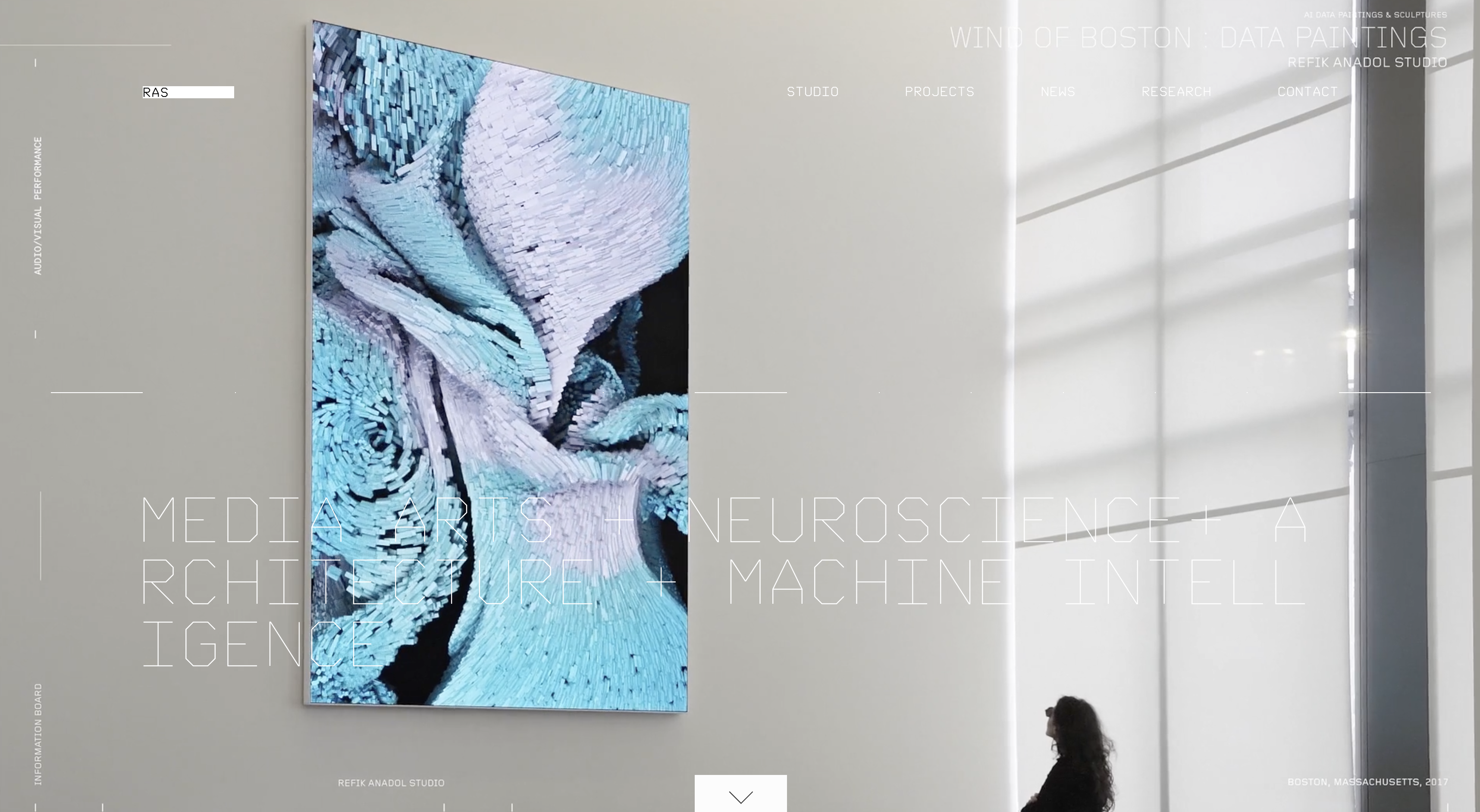
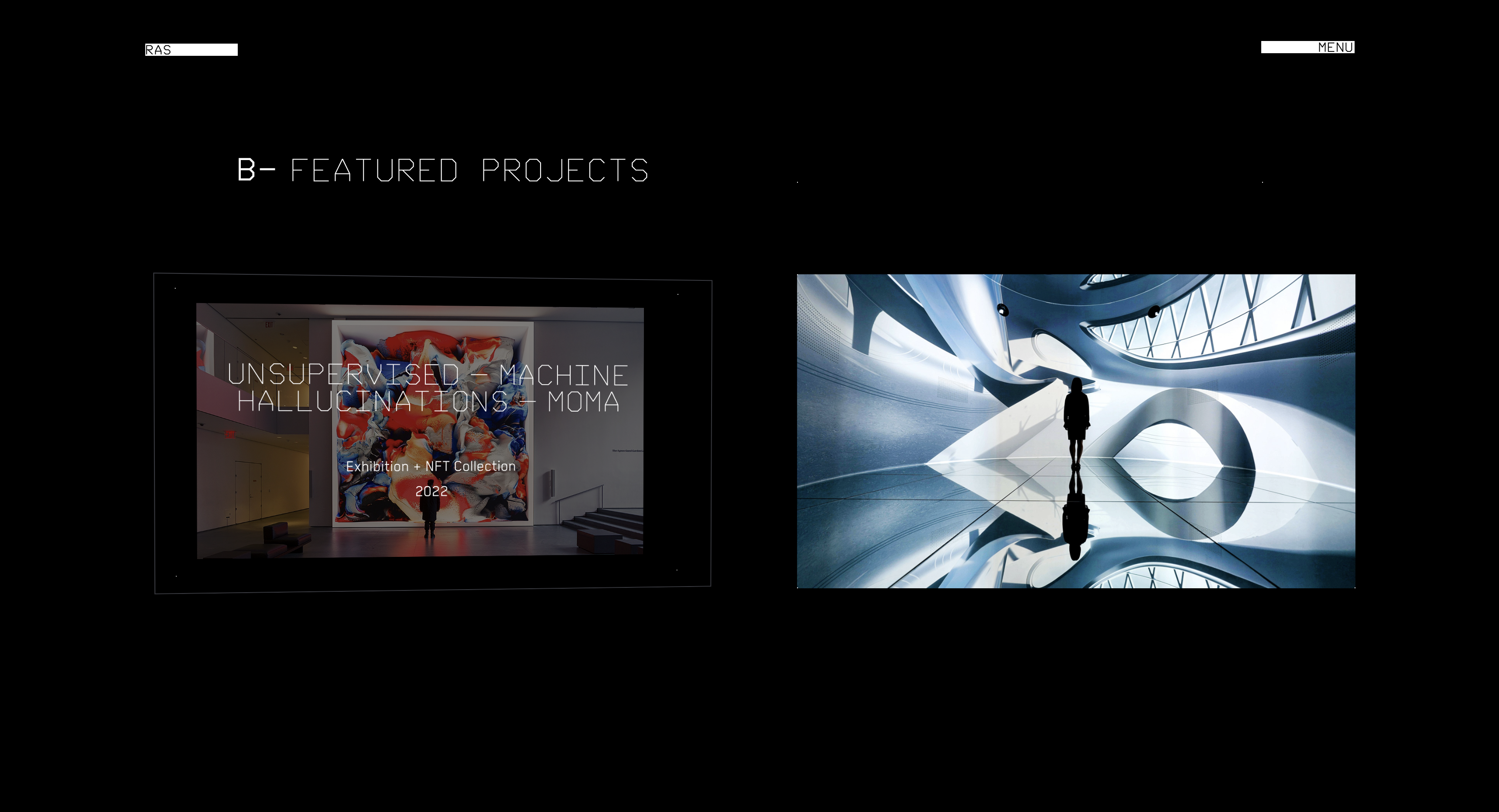
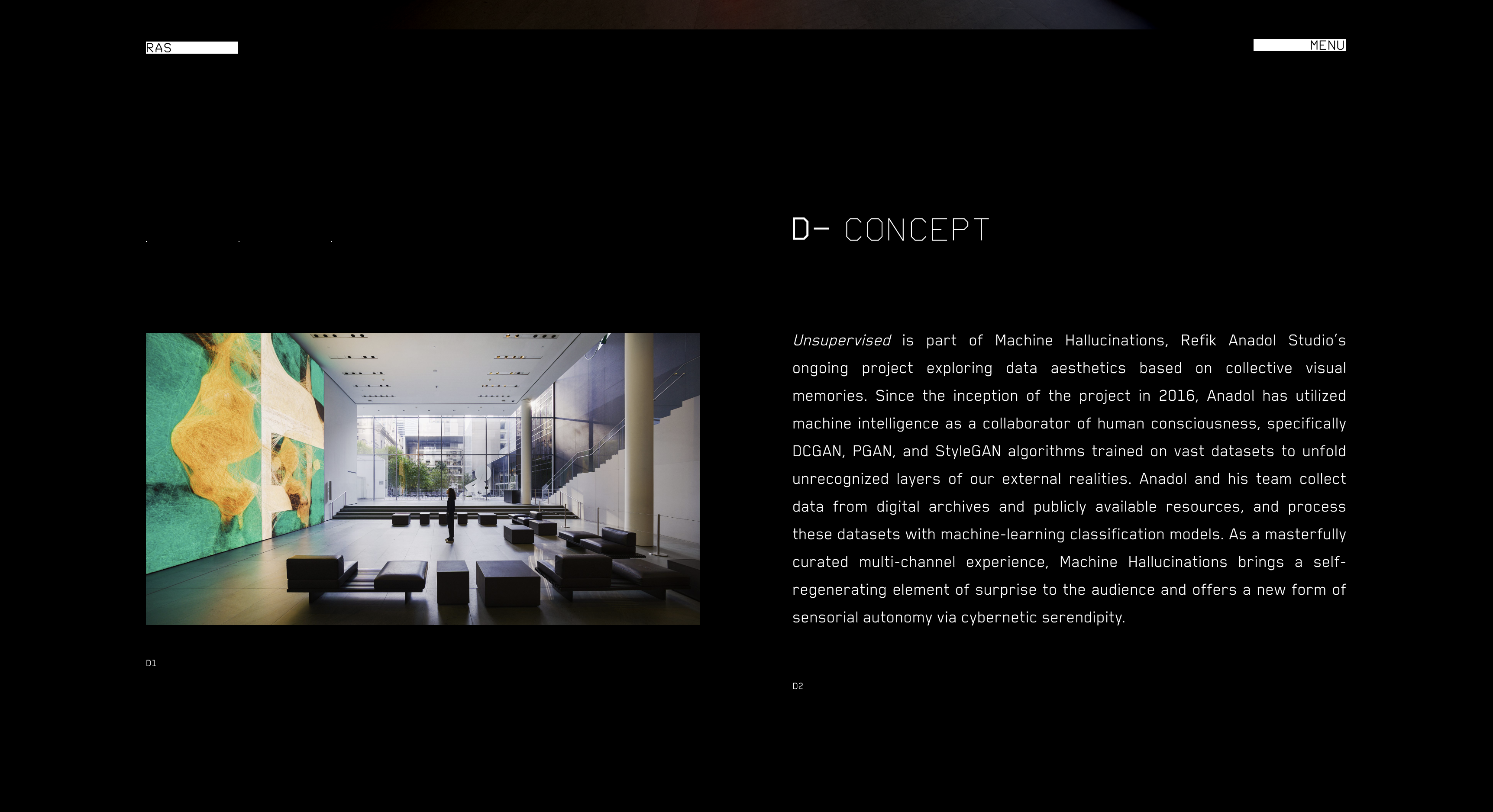
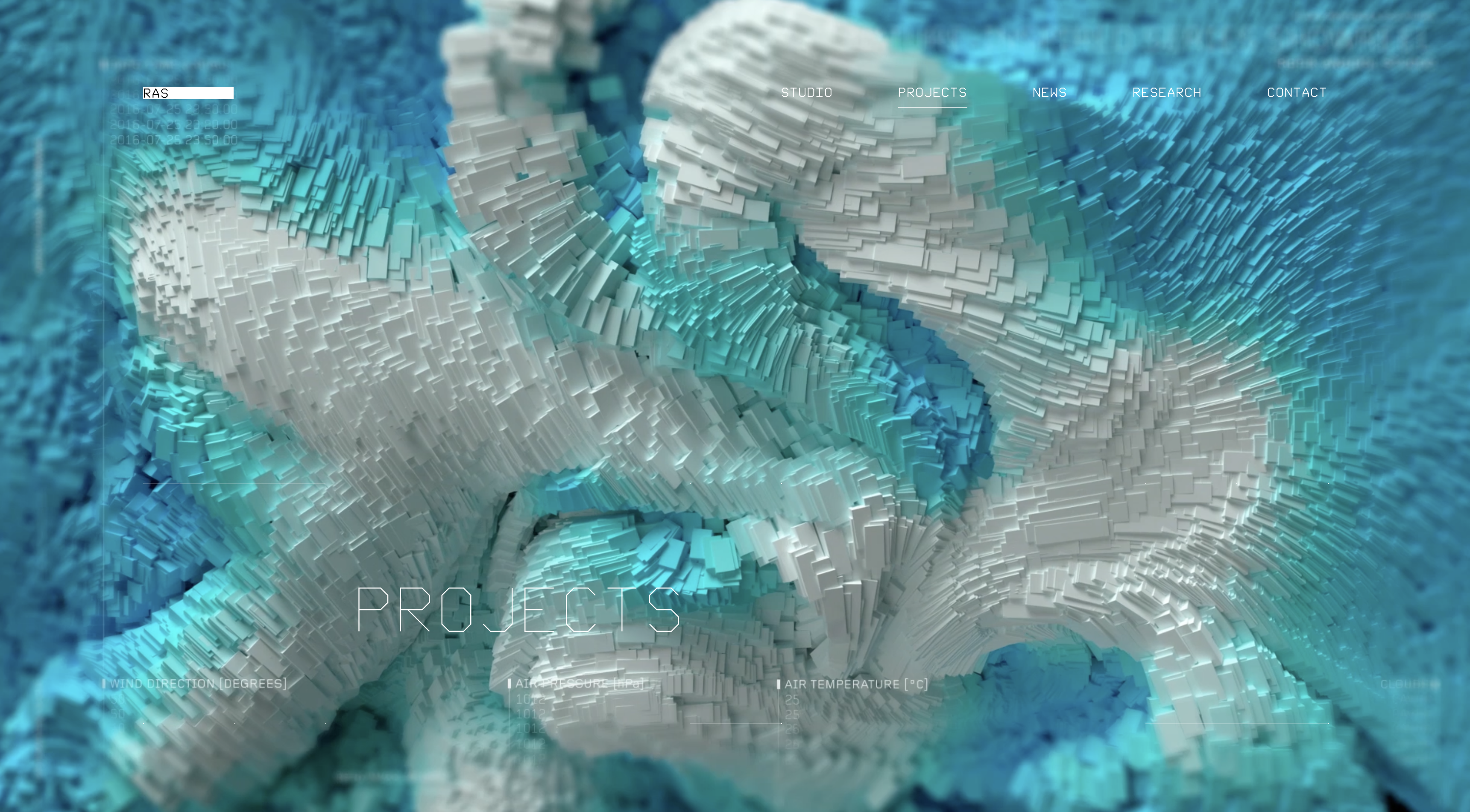
The website provides a distinctive digital platform for presenting Refik Anadol Studio’s projects, research initiatives, and cultural activities. Through dynamic layouts and extensive motion design, the platform creates a living visual system that feels aligned with the studio’s exploration of generative processes while remaining practical for everyday content management and publishing.
This project demonstrates how interaction design, motion design, and content systems can become integral parts of a brand’s identity rather than decorative additions. The dynamic layout engine introduces controlled variability into the user experience, ensuring that each visit feels slightly different while preserving structure and readability. Combined with a custom-built WordPress architecture and extensive animation system, the project showcases a close integration of design thinking and engineering execution.
RD Content
2020–Present
Design and development of the corporate website for RD Content, an international content marketing and production agency working with global brands. The project focused on creating a modern, scalable platform capable of presenting services, case studies, industry expertise, and company information while supporting ongoing content publishing and business development activities.
Developed a clear information architecture focused on discoverability and usability
Designed a custom visual system tailored to the agency’s brand and content requirements
Built a fully bespoke WordPress theme from scratch without relying on pre-built templates
Created reusable content modules to support flexible page creation and editorial workflows
Optimised layouts and interactions for desktop, tablet, and mobile devices
Established a maintainable platform capable of evolving alongside the business
Provided ongoing maintenance and technical support following launch
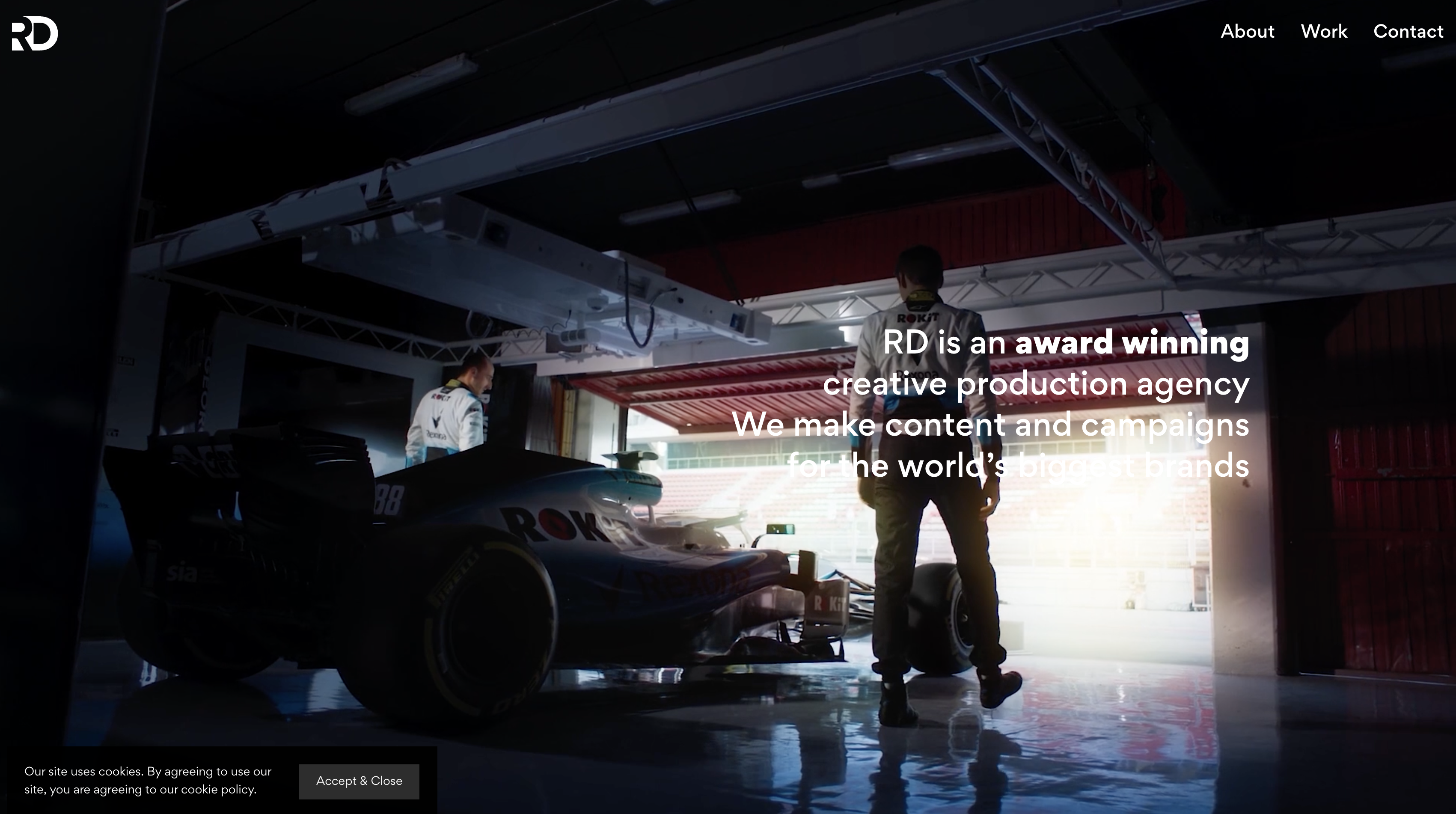
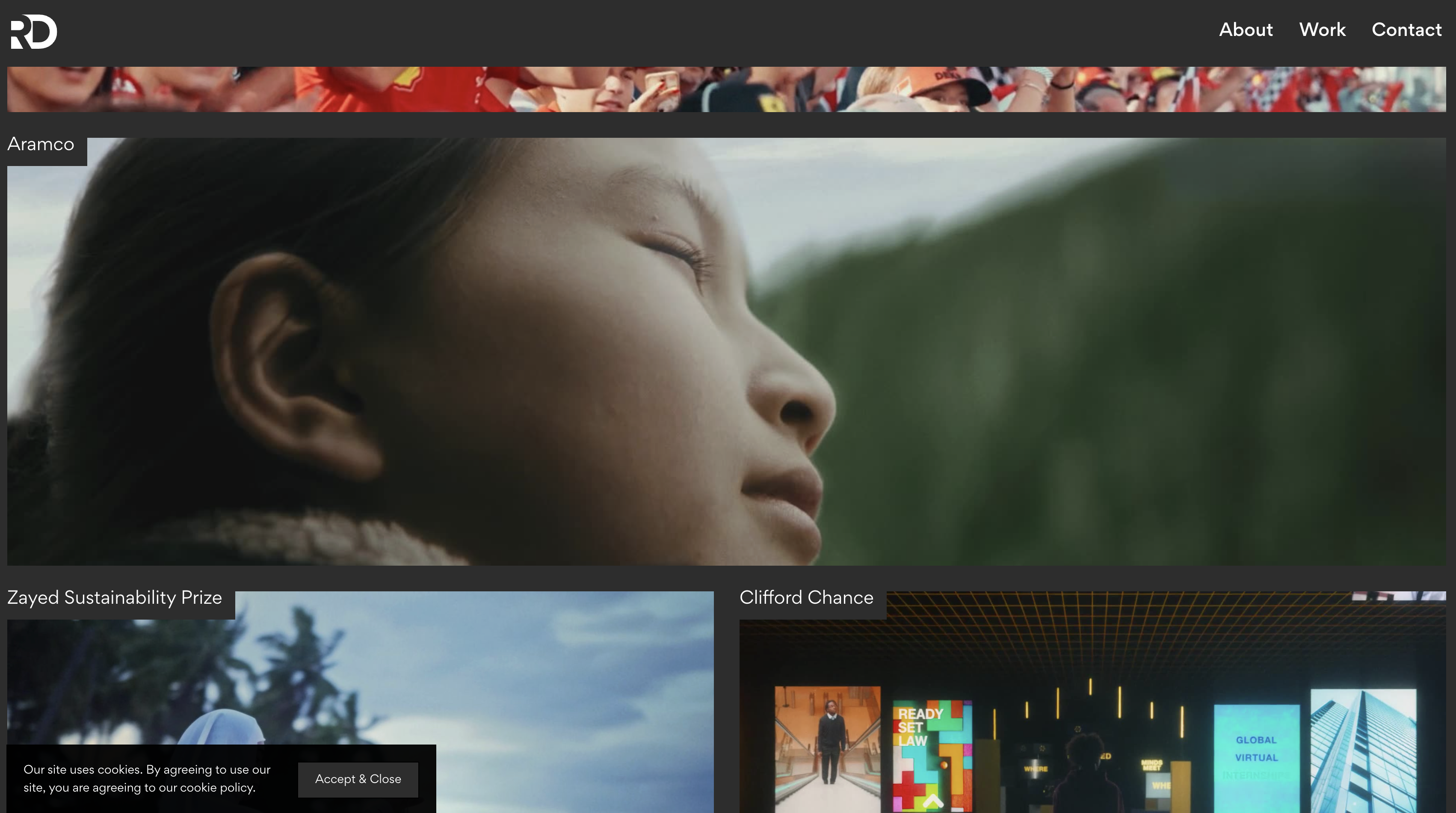
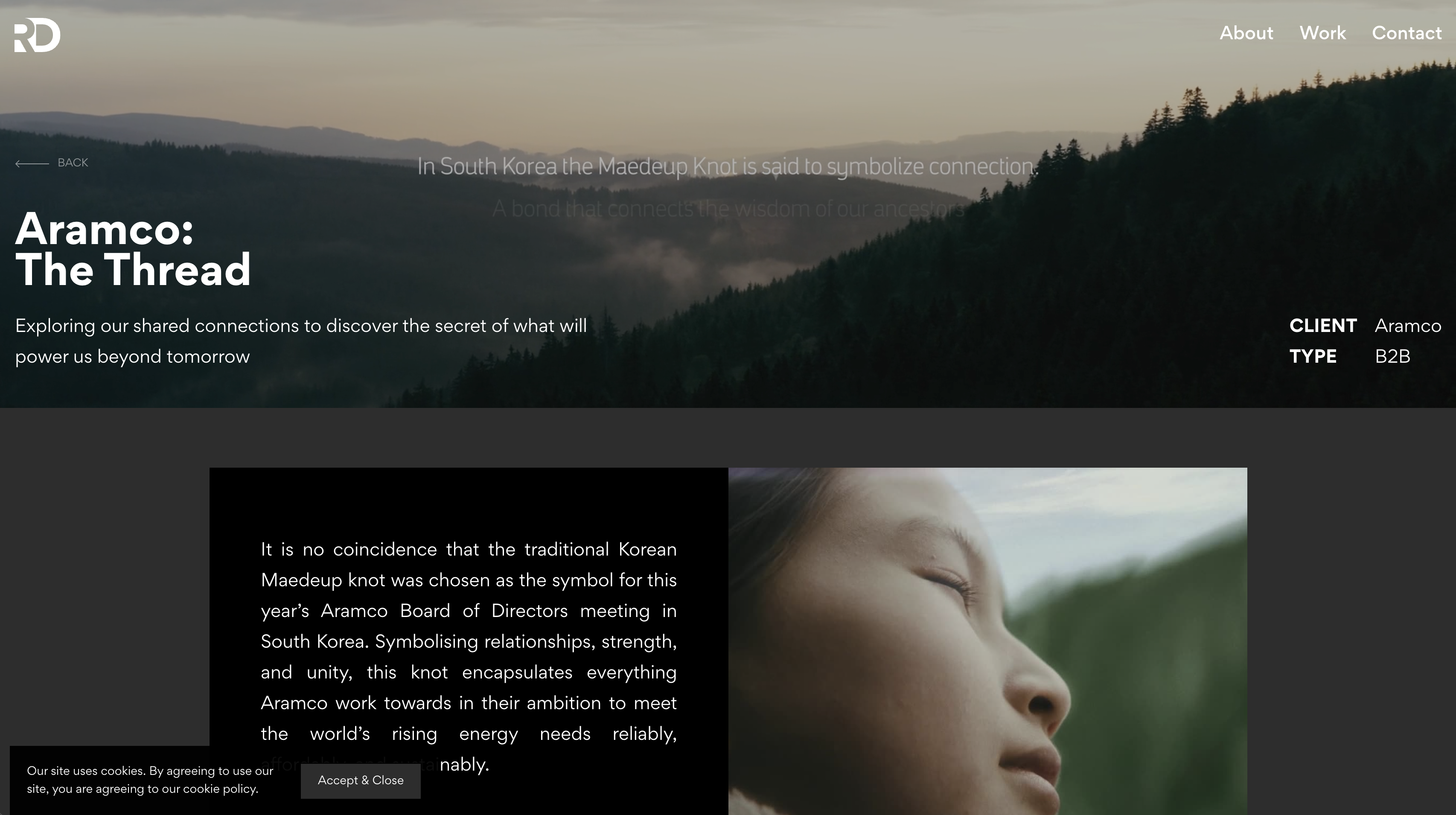
The resulting platform provides RD Content with a flexible and maintainable website that supports marketing, publishing, and business development activities. The bespoke content management system enables the team to manage a growing library of case studies, insights, and service-related content while maintaining consistency across the site.
The project demonstrates the value of designing and engineering content-focused platforms from the ground up rather than adapting generic templates. By creating a custom WordPress theme and tailored content architecture, the website was able to address the specific needs of a growing international agency while providing a strong foundation for long-term maintenance and future development.
Salon Architects
2018–Present
Design and development of the website for Salon Architects, a contemporary architectural practice known for its research-driven and progressive approach to design. Rather than presenting projects through a conventional portfolio structure, the website introduces a dynamic layout system in which the arrangement of content changes with each visit, creating a constantly evolving experience that reflects the studio’s experimental attitude towards architecture and spatial thinking.
Developed a custom visual identity system built around flexibility and variation
Designed a dynamic layout engine that randomises the position and arrangement of content on every page load
Used controlled randomness to create unique compositions while preserving readability and navigation
Integrated the custom interface into a bespoke WordPress theme developed from scratch
Implemented multilingual content management for English and German audiences
Optimised the experience for desktop, tablet, and mobile devices
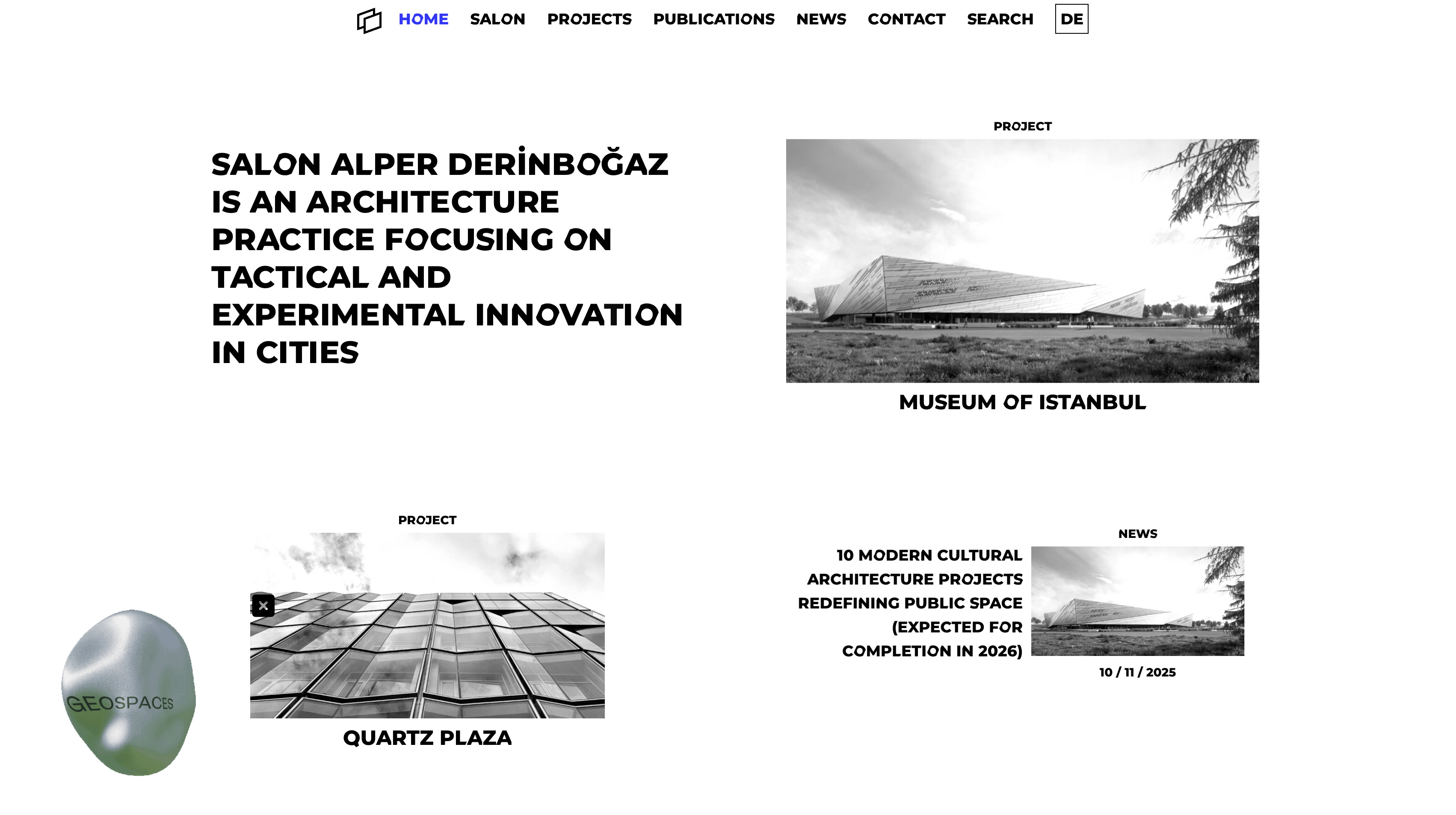
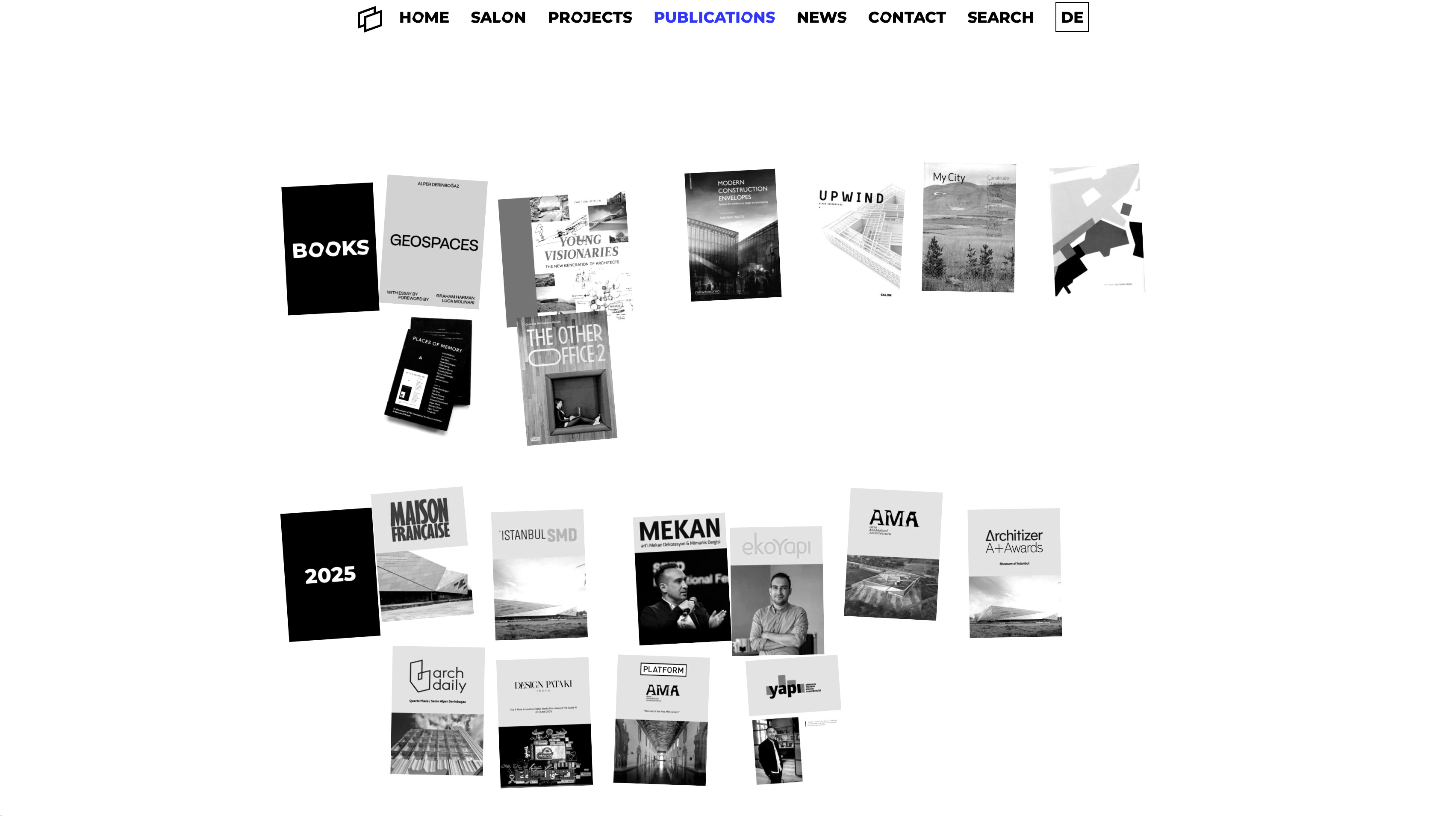
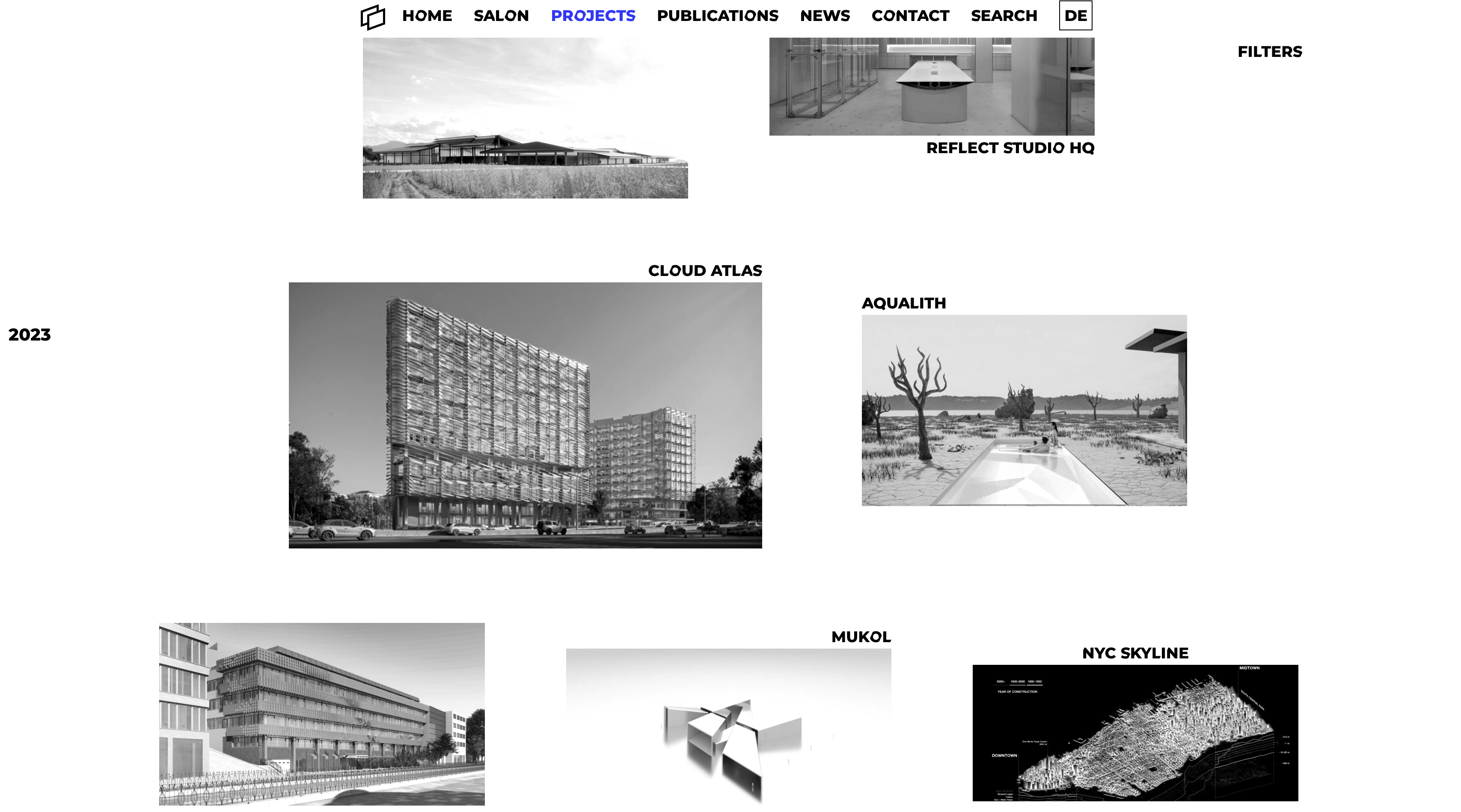
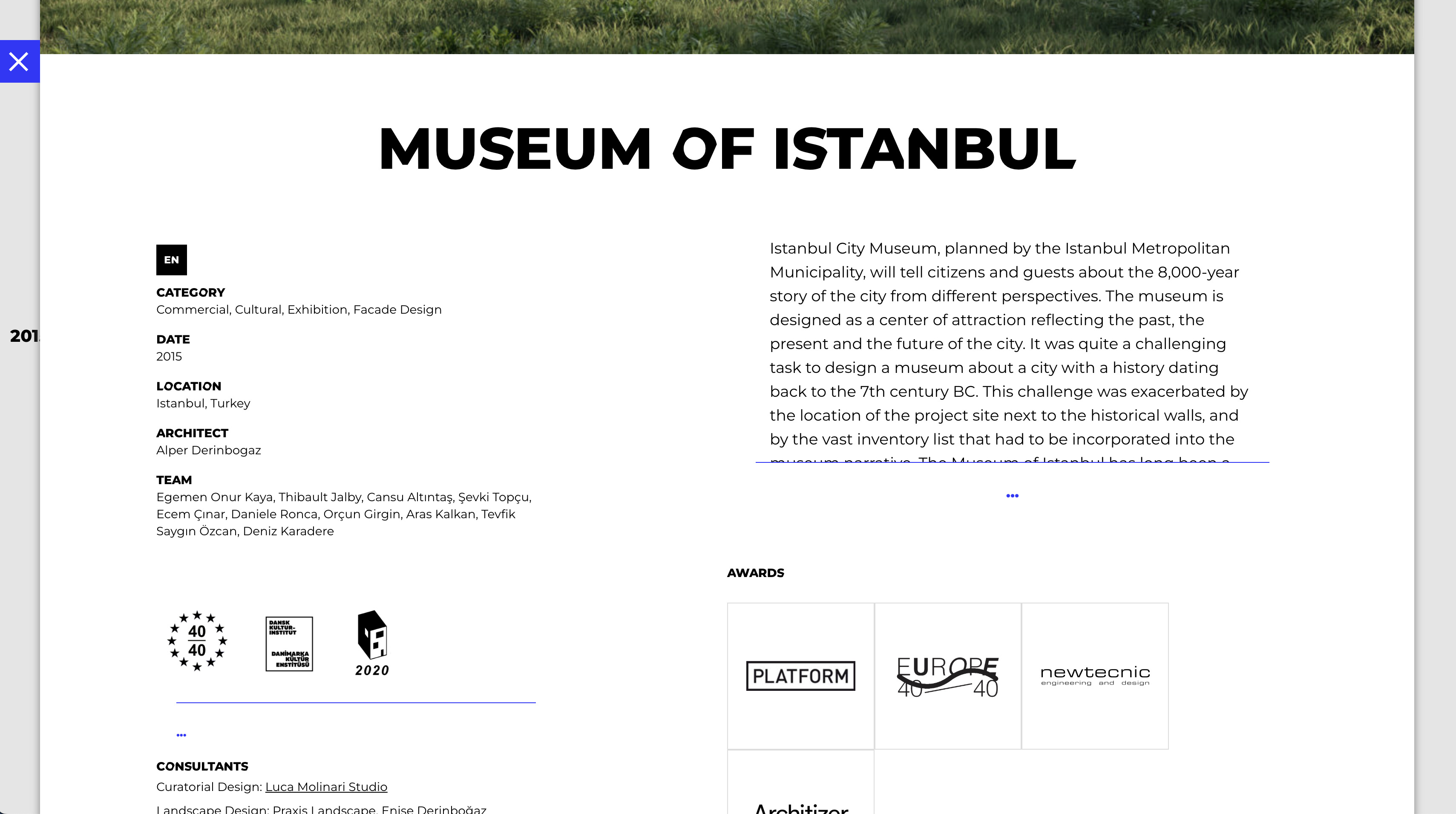
The website provides Salon Architects with a digital platform that reflects the studio’s architectural philosophy through behaviour as much as appearance. The constantly changing layouts create a sense of discovery and experimentation while maintaining a clear framework for presenting projects, research, and studio information. The result is a portfolio experience that feels less like a catalogue and more like an evolving spatial system.
Architecture websites often rely on highly predictable portfolio structures and fixed grids. This project explored how digital space itself could become part of the architectural narrative. By introducing controlled randomness and dynamic composition, the website mirrors the studio’s interest in experimentation, research, and alternative ways of organising information. The project demonstrates how interaction design and system design can reinforce a brand’s intellectual and creative position rather than simply displaying content.
Salon Architects
2018
Brand identity design for Salon Architects, an international architecture practice led by Alper Derinboğaz. The identity was developed to reflect the studio’s progressive and research-driven approach to architecture through a distinctive typographic system that balances clarity, structure, and experimentation. At the centre of the identity is a custom display typeface featuring diagonal cuts inspired by the letters in the word SALON, creating a recognisable visual signature used consistently across digital and printed applications.
Explored the architectural qualities of typography as the foundation of the identity system
Developed a custom display typeface featuring diagonal cuts derived from the SALON letterforms
Used the modified typography as both logo and visual language rather than creating separate graphic devices
Applied the typographic system consistently across digital, editorial, and printed materials
Integrated the identity into the studio's website and communication materials to create a unified brand experience
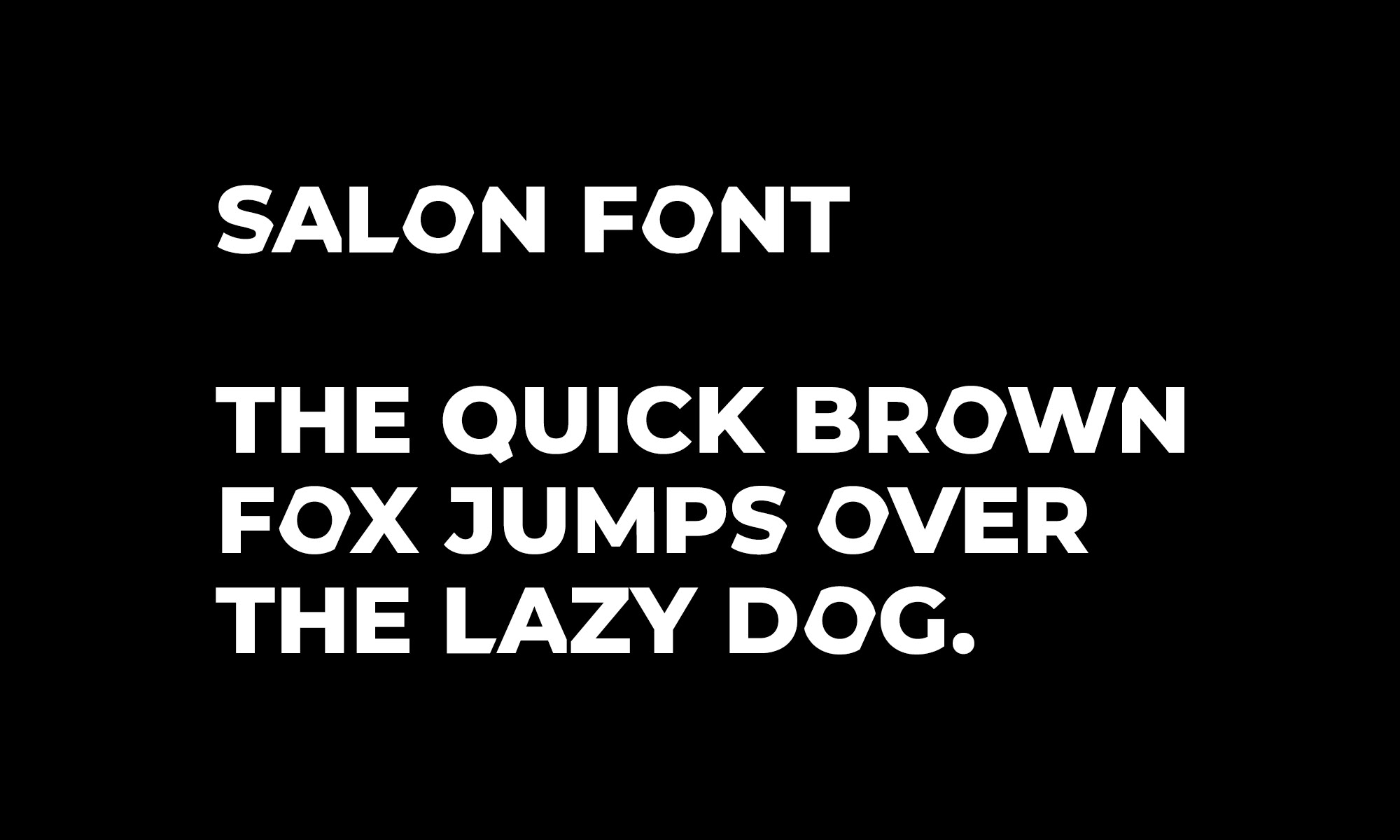
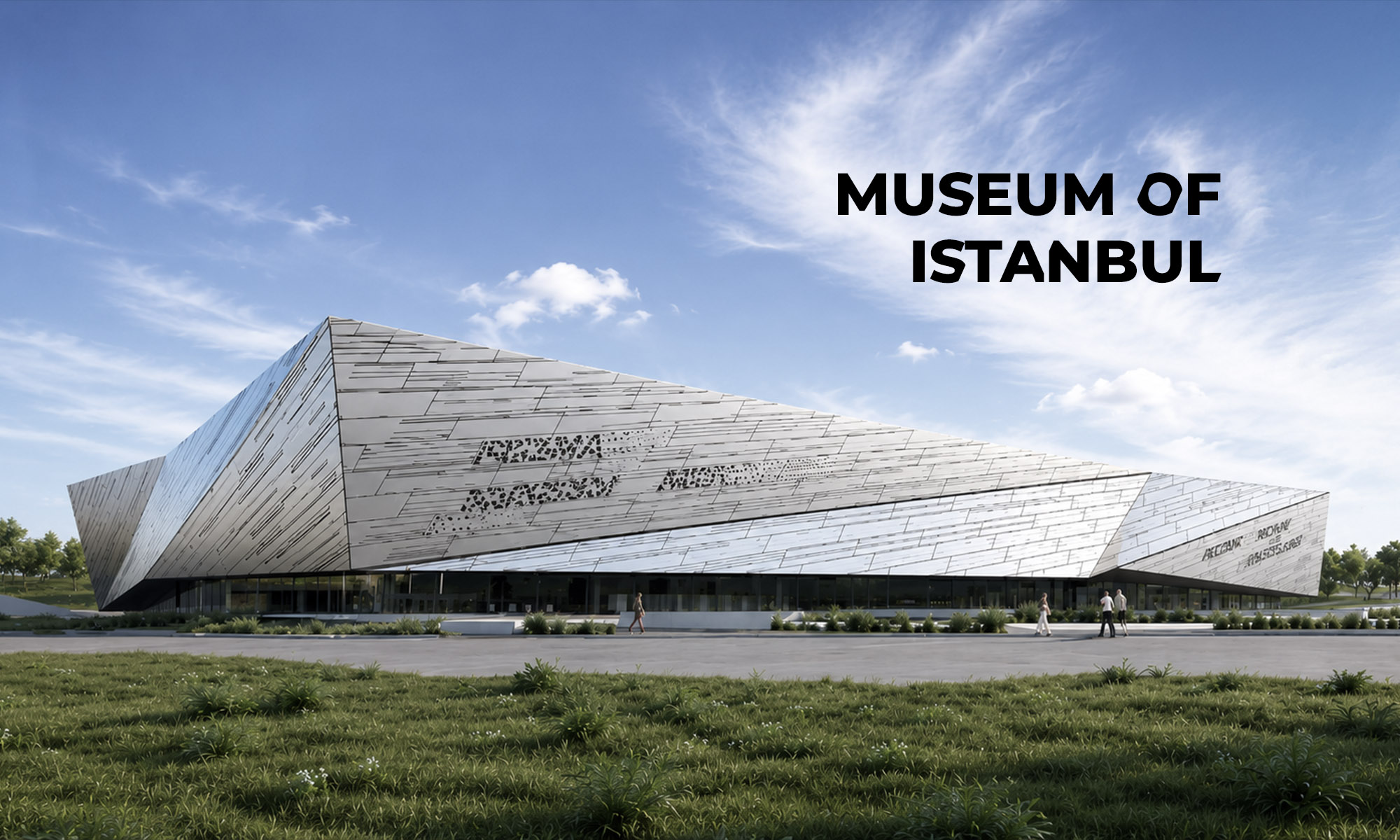
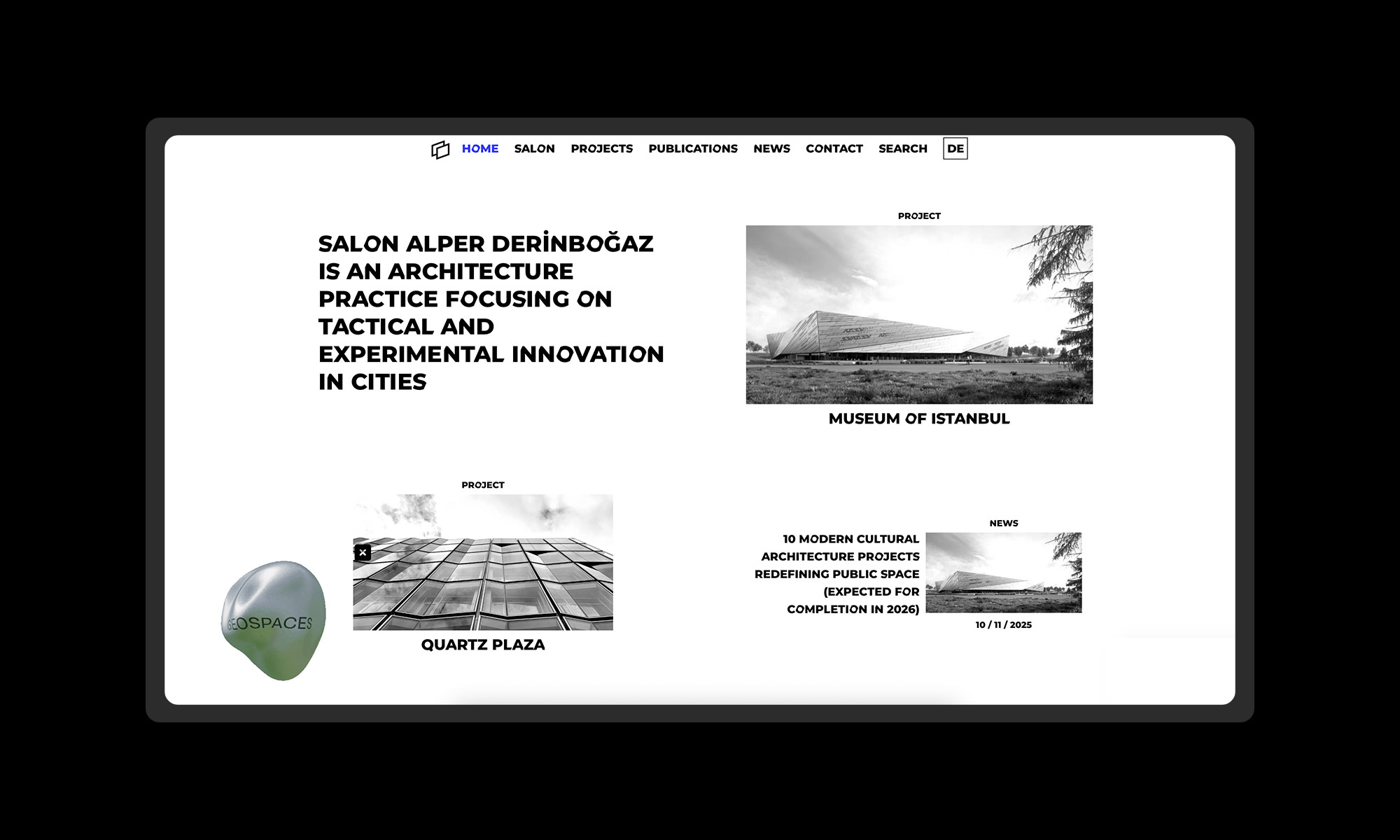
The resulting identity provides Salon Architects with a distinctive and recognisable visual presence centred on typography. The custom letterforms create a strong connection between the studio's name and its visual language, while the simplicity of the system allows it to adapt across websites, presentations, printed materials, and future communications.
Many architecture identities rely on neutral typography and minimal graphic treatment. This project explored how a small but deliberate modification to letterforms could become the foundation of an entire identity system. The diagonal cuts introduce a subtle sense of movement, intervention, and precision that echoes the studio’s approach to architecture. By extending the custom typography across both digital and physical applications, the identity creates a coherent and memorable presence without relying on decorative graphic elements.
Beyza Boyacıoğlu, Jeff Soyk
2017
Zeki Müren Hotline is an award-winning interactive documentary and participatory web experience exploring the cultural legacy of Zeki Müren, one of Turkey’s most beloved and influential performers. Originating from a public telephone hotline that invited people to leave messages for the late artist, the project transforms hundreds of recorded memories into an interactive digital archive. Through audio recordings, archival imagery, and historical narratives, the experience examines collective memory, nostalgia, identity, fandom, and social change in modern Turkey.
Developed a custom interactive web platform centred around audio storytelling
Created navigation systems that allow visitors to discover stories non-linearly
Integrated archival imagery, historical context, and participant recordings into a unified experience
Focused on accessibility, responsiveness, and long-term preservation of cultural material
The project premiered at IDFA DocLab and was nominated for the Digital Storytelling Award. It has been exhibited internationally, including in Istanbul, Amsterdam, Montreal, Freiburg, and New York. The project later received a Webby Award Honoree distinction and a CSS Design Awards Special Kudos. It remains an important example of participatory documentary storytelling, combining collective memory, cultural history, and digital interaction.
Zeki Müren Hotline demonstrates how digital platforms can extend documentary practice beyond traditional film formats. By transforming hundreds of personal voice messages into an interactive archive, the project preserves cultural memory while inviting audiences to actively explore stories rather than passively consume them. The work sits at the intersection of technology, storytelling, participation, and cultural heritage.
Pinar & Viola
2017–2020
Website design and development for Pinar & Viola, the Paris-based artist duo known for their surreal digital imagery, speculative futures, and culturally provocative visual narratives. The platform served as the primary archive and presentation space for their artworks, collections, exhibitions, collaborations, writings, and commercial projects, bringing together a large and diverse body of work within a unified digital experience.
Designed a custom visual system inspired by the artists’ vibrant and unconventional aesthetic
Developed a bespoke WordPress theme tailored to the structure of their practice
Created flexible content modules for artworks, collections, exhibitions, publications, and collaborations
Focused on responsive layouts and image presentation to support highly visual storytelling
The website became the central digital platform for presenting Pinar & Viola’s multidisciplinary practice, supporting exhibitions, publications, commercial collaborations, and ongoing artistic research. It provided a scalable foundation for showcasing years of work while maintaining the distinctive personality that defined the duo’s internationally recognised visual identity.
The project demonstrates the challenge of designing for artists whose work intentionally embraces complexity, contradiction, and visual excess. Rather than imposing a neutral portfolio structure, the website was designed as an extension of the artists’ world, creating a digital environment capable of housing experimental ideas while remaining accessible to curators, collaborators, collectors, and the wider public.
Kraken
2017–2020
Designed and developed the official website for Kraken, an award-winning animation and motion design studio operating between Istanbul and London. The platform was created to showcase the studio’s growing portfolio of title sequences, broadcast branding projects, commercials and visual storytelling work through a custom-built WordPress experience tailored to the needs of a creative production studio.
Designed a clean and visually focused interface that prioritised project imagery and storytelling
Developed a fully custom WordPress theme tailored specifically to Kraken’s workflow and content structure
Created reusable content modules to simplify project publishing and portfolio management
Implemented responsive layouts to ensure a consistent experience across devices
Provided ongoing maintenance and technical support throughout the collaboration
The website became Kraken’s primary online presence during a period of international growth, providing a professional platform for presenting award-winning work and supporting client engagement across both London and Istanbul operations.
The project demonstrates the ability to translate the identity of a highly visual creative studio into a tailored digital platform. Rather than relying on templates, the website was designed and built around the specific needs of Kraken’s portfolio, workflow and audience, creating a system that remained useful and maintainable over multiple years.
Jakuzi
2017
Designed and developed the official website for Jakuzi, the Istanbul-based synth-wave and post-punk band known for blending dark wave, krautrock and Turkish underground music influences. The website was created during a period when the band was gaining international recognition following the release of their debut album 'Fantezi Müzik' and their growing presence within the global independent music scene.
Developed a minimal and atmosphere-driven visual language inspired by the band’s music and aesthetics
Focused on typography, imagery and pacing to create an emotionally resonant browsing experience
Designed and coded a custom front-end tailored specifically to the identity of the band
Created a responsive and lightweight experience optimised across devices
Prioritised simplicity and mood over heavy interface complexity
The website provided Jakuzi with a dedicated digital platform during a defining stage of their international emergence. It supported the presentation of the band’s music, identity and growing cultural presence while reinforcing the emotional and visual tone associated with their work.
The project reflects an approach to music-related digital design where atmosphere, emotion and cultural identity are treated as central design materials. Rather than functioning purely as a promotional website, the platform aimed to extend the emotional world of Jakuzi into a digital environment aligned with the band’s artistic voice.
Holocene Advisors
2017–2024
Designed and developed the website for Holocene Advisors, a New York-based investment management firm specialising in long/short and long-only equity strategies. The project focused on creating a clear, confident and institutionally aligned digital presence that reflected the company’s research-driven culture, analytical approach and long-term investment philosophy.
Designed a clean and restrained interface focused on typography, structure and clarity
Developed a custom WordPress platform tailored to the firm’s communication and content management needs
Built flexible page systems and reusable content modules to support future expansion
Focused on responsive performance and accessibility across devices
Provided long-term technical support and maintenance throughout the collaboration
The resulting platform established a refined and professional digital presence for Holocene Advisors, supporting the company’s communication with investors, partners and future team members while remaining maintainable and adaptable over multiple years.
The project demonstrates the ability to create digitally sophisticated experiences outside of the creative industry, adapting design and engineering approaches to a finance and investment context where clarity, trust and long-term stability are essential. The collaboration also reflects experience in building custom digital systems intended for long operational lifecycles rather than short-term campaigns.
ATÖLYE
2017–2019
Designed and developed the website for ATÖLYE, a multidisciplinary design and innovation studio operating between Istanbul and Dubai. ATÖLYE works across strategy, systems thinking, service design, spatial design, learning and community building, collaborating with organisations ranging from startups and cultural institutions to governments and global companies. The project focused on creating a digital platform capable of communicating the studio’s interdisciplinary structure, collaborative culture and international positioning.
Designed a clean and structured interface system focused on clarity, modularity and readability
Developed a custom WordPress platform tailored to the studio’s publishing and communication needs
Created flexible content structures capable of supporting projects, research, programmes and editorial content
Focused on responsive performance and long-term maintainability
Worked closely with the ATÖLYE team across multiple digital projects over several years
The resulting platform supported ATÖLYE during a period of international expansion and increasing global visibility, helping communicate the organisation’s work, culture and multidisciplinary approach to audiences across multiple regions and industries.
The project reflects experience working with organisations operating at the intersection of design, strategy, systems thinking and cultural transformation. It also represents a long-term collaboration involving multiple digital projects and close interaction with a highly interdisciplinary team connected to the global kyu Collective network.
Lindy Ceramics
2016
Designed the visual identity and logo for Lindy Ceramics, a ceramics practice connected to swing dance culture and handcrafted artistic production. The identity centred around a custom heart-shaped symbol inspired by the name ‘Lindy’, which originates from Lindy Hop, the historic African American jazz dance. The logo combines softness, rhythm and human warmth within a minimal geometric form.
Developed a custom typographic symbol integrating the word ‘Lindy’ into a heart-shaped structure
Used continuous curved line forms to reference movement, rhythm and handcraft
Focused on simplicity and recognisability to ensure strong scalability across mediums
Balanced geometric precision with organic flow to reflect both design structure and handmade production
Created a monochromatic identity system adaptable across packaging, digital and physical surfaces
The resulting identity established a recognisable and emotionally warm visual language for Lindy Ceramics, combining references to swing dance culture, human connection and handcrafted artistic production within a minimal contemporary mark.
The project demonstrates an approach to identity design where cultural references, movement and emotional associations are embedded directly into the structure of the symbol itself. Rather than relying on decorative ceramics clichés, the logo creates a more personal and conceptual connection through rhythm, typography and form.
Karşılaşmalar
2016–2020
Designed and developed the website for Karşılaşmalar, an Istanbul-based interdisciplinary cultural platform focused on essays, interviews, conversations and artistic dialogue. The project aimed to create an immersive editorial experience that combined contemporary digital interaction with long-form cultural publishing.
Designed a typography-led interface system focused on pacing, atmosphere and readability
Integrated motion and interaction as part of the editorial experience rather than decorative additions
Developed custom animations and transitions using GSAP
Used Three.js to introduce immersive visual elements and spatial depth
Built a custom WordPress platform tailored for editorial publishing and long-term flexibility
The resulting platform established a distinctive digital identity for Karşılaşmalar, combining cultural publishing with immersive interaction and motion-driven storytelling. The website supported the platform’s role within Istanbul’s independent cultural and intellectual landscape.
The project represents an early exploration of combining editorial publishing with real-time motion, spatial interaction and experimental web technologies. Rather than separating content and interaction, the platform treated digital atmosphere, movement and reading experience as interconnected parts of a single cultural environment.
IPD Architecture
2016–Present
Designed and developed the website for IPD Architecture, an Istanbul-based architecture and interior architecture studio working across residential, hospitality, retail, office, healthcare and cultural projects. The platform was created to present the studio’s broad architectural portfolio through a clean and highly visual digital experience supported by a custom-built administration system.
Designed a minimal and architecture-focused interface centred around imagery, layout rhythm and spatial clarity
Developed the platform using a custom PHP-based infrastructure rather than relying on prebuilt CMS systems
Built a fully custom administration panel tailored specifically to IPD’s content workflow
Integrated smooth interface transitions and interaction systems using GSAP
Used Three.js selectively to introduce depth and interactive visual elements within the browsing experience
Maintained and evolved the platform through long-term collaboration
The resulting platform provided IPD Architecture with a long-term digital portfolio system capable of presenting architectural work across multiple disciplines while remaining flexible, maintainable and visually aligned with the studio’s design approach.
The project reflects an approach to architectural digital presentation where interaction, motion and spatial pacing are treated as extensions of architectural thinking itself. It also demonstrates long-term experience building custom digital systems tailored specifically to the workflows and presentation needs of architecture studios.
Seslenen Kitap
2015
Created visual design work for Seslenen Kitap, one of Türkiye’s early audiobook and digital listening platforms. The collaboration included website design and graphic design materials developed to support the company’s growing digital presence during the early expansion of audiobook culture in the Turkish market.
Developed clean and accessible interface designs focused on usability and clarity
Created graphic design materials aligned with the company’s publishing and digital identity
Focused on modern typography and simplified visual systems suitable for mobile-first audiences
Balanced technology and cultural publishing aesthetics within the visual direction
Designed with flexibility in mind to support the platform’s evolving digital presence
The resulting visual language supported Seslenen Kitap during an important period in the early development of Türkiye’s audiobook ecosystem, helping establish a recognisable and contemporary digital presence within the publishing and technology sectors.
The project represents early experience working within digital publishing and audio-focused platforms before audiobook services became mainstream in the region. It also reflects an interest in projects positioned at the intersection of culture, technology and changing media consumption habits.
Kolektif House
2015
Designed the website for Kolektif House, one of the pioneering coworking and flexible office companies to emerge from Türkiye’s startup and entrepreneurial ecosystem. The project focused on creating a contemporary digital identity capable of reflecting the company’s community-oriented, design-led and collaborative approach to workspace culture.
Developed a clean and contemporary visual direction inspired by modern startup culture and collaborative work environments
Focused on clarity, openness and accessibility within the interface system
Used strong typography and spacious layouts to reflect flexibility and community-oriented thinking
Created a digital aesthetic positioned between technology, hospitality and creative culture
Designed with scalability in mind to support the company’s rapid growth
The resulting website established a contemporary and recognisable digital identity for Kolektif House during the early growth of coworking culture in Türkiye, helping communicate the company’s design-focused and community-driven approach to modern workspaces.
The project reflects early involvement with companies shaping new models of work, entrepreneurship and creative collaboration within Istanbul’s startup ecosystem. It also demonstrates an approach to digital design focused not only on presenting physical spaces, but also on communicating culture, atmosphere and social interaction.
Hipo Labs
2015
Developed the website for Hipo Labs, an Istanbul-based digital product and software development company known for building products for startups and international technology companies. The project focused on translating the studio’s contemporary visual language into a responsive and interaction-rich front-end experience.
Developed the front-end architecture using responsive HTML, CSS and JavaScript
Implemented interface transitions and animation systems using jQuery-based workflows
Created micro animations to improve pacing, responsiveness and interaction quality
Focused on smooth scrolling, hover states and subtle motion behaviours throughout the interface
Worked closely with the visual design direction to preserve interaction precision across devices
The resulting platform provided Hipo Labs with a smooth and interaction-focused digital presence aligned with the company’s technology and product-driven identity, helping communicate a contemporary engineering and startup culture.
The project reflects early experience building animation-rich front-end systems during a period when highly interactive product websites were becoming increasingly important within startup and technology culture. It also demonstrates a focus on motion, responsiveness and interaction quality as core parts of the user experience.
DKD Yapı
2015
Designed the logo and visual identity for DKD Yapı, an Istanbul-based international construction and engineering company operating across Türkiye, Central Asia and Europe. The identity system was created to communicate structural strength, technical precision and large-scale operational capability through a bold and contemporary visual language.
Developed a bold typographic logo system centred around structural rhythm and repetition
Integrated flowing linear patterns into the letterforms to reference construction layers, material systems and engineered structures
Used a monochromatic and high-contrast visual language to reinforce clarity and strength
Created a flexible identity suitable for vehicles, construction signage, documents and digital platforms
Focused on timeless geometric construction rather than trend-based styling
The resulting identity established a distinctive and contemporary visual presence for DKD Yapı, helping position the company beyond conventional construction branding through a cleaner and more design-oriented visual system.
The project reflects an approach to identity design where industrial and engineering-focused companies are treated with the same level of conceptual and visual precision often reserved for cultural or technology brands. The identity aimed to communicate structure, rhythm and technical confidence through the form of the logo itself.
DAY Studio
2015–Present
Designed, developed and maintained the website for DAY Studio, an Istanbul-based multidisciplinary industrial design practice working across furniture, lighting, textiles, tableware and product design. The platform was created as a minimal and highly refined digital environment focused on presenting objects, materials and spatial atmosphere with precision and restraint.
Designed a restrained interface system centred around typography, spacing and image composition
Developed custom front-end interactions focused on micro animations and subtle motion behaviours
Used minimal transitions and interface pacing to support the tactile and material qualities of the work
Built a lightweight HTML-based structure prioritising responsiveness and performance
Provided ongoing maintenance and hosting support throughout the long-term collaboration
The resulting platform established a refined and long-lasting digital presence for DAY Studio, supporting the presentation of products, collections and exhibitions while remaining visually restrained, fast and maintainable over multiple years.
The project reflects an approach to digital design where restraint, pacing and interaction precision become central design materials. Rather than relying on large gestures or complex interface systems, the platform focused on subtle movement, atmosphere and clarity to support the studio’s object-focused design philosophy.
Prizma Art Gallery
2015
Designed and developed the website and visual identity system for Prizma Art Gallery, an Istanbul-based independent contemporary art and expanded cinema space focused on new media art, experimental film and immersive audiovisual practices. The project combined branding, interaction design and motion-focused front-end development into a single cohesive digital experience.
Developed the branding and visual identity alongside the website experience
Designed an interactive homepage using motion and spatial transitions as central interface elements
Implemented micro animations and animated transitions throughout the browsing experience
Used GSAP to create smooth motion systems and interaction choreography
Built a lightweight custom HTML front-end focused on responsiveness and visual pacing
The resulting platform established a visually distinctive digital presence for Prizma Art Gallery, extending the gallery’s experimental and media-oriented identity into an interactive web environment connected to contemporary art, moving image culture and expanded cinema practices.
The project represents an early exploration of combining branding, motion systems and interactive web experiences within a cultural context. Rather than treating the website as a static information platform, the project approached the interface itself as part of the gallery’s curatorial and atmospheric expression.
Prizma Art Gallery
2015
Designed and developed the visual identity system and interactive website for Prizma Art Gallery, an Istanbul-based independent contemporary art and expanded cinema space focused on new media art, experimental film and immersive audiovisual practices. The project combined branding, custom typography, exhibition graphics and interactive digital design into a unified visual system.
Developed the identity around themes of light, reflection, optical fragmentation and projection inspired by the meaning of the word ‘Prizma’
Created a customised version of Neutraface named ‘Prizma Font’ as part of the visual identity system
Applied the typeface consistently across the website, exhibition graphics, printed programmes and communication materials
Designed and developed an interactive homepage centred around a dynamic kaleidoscope experience
Allowed users to interact with the kaleidoscope using mouse movement and custom image uploads
Integrated motion, animation and spatial transitions into the digital experience to reflect the gallery’s curatorial focus
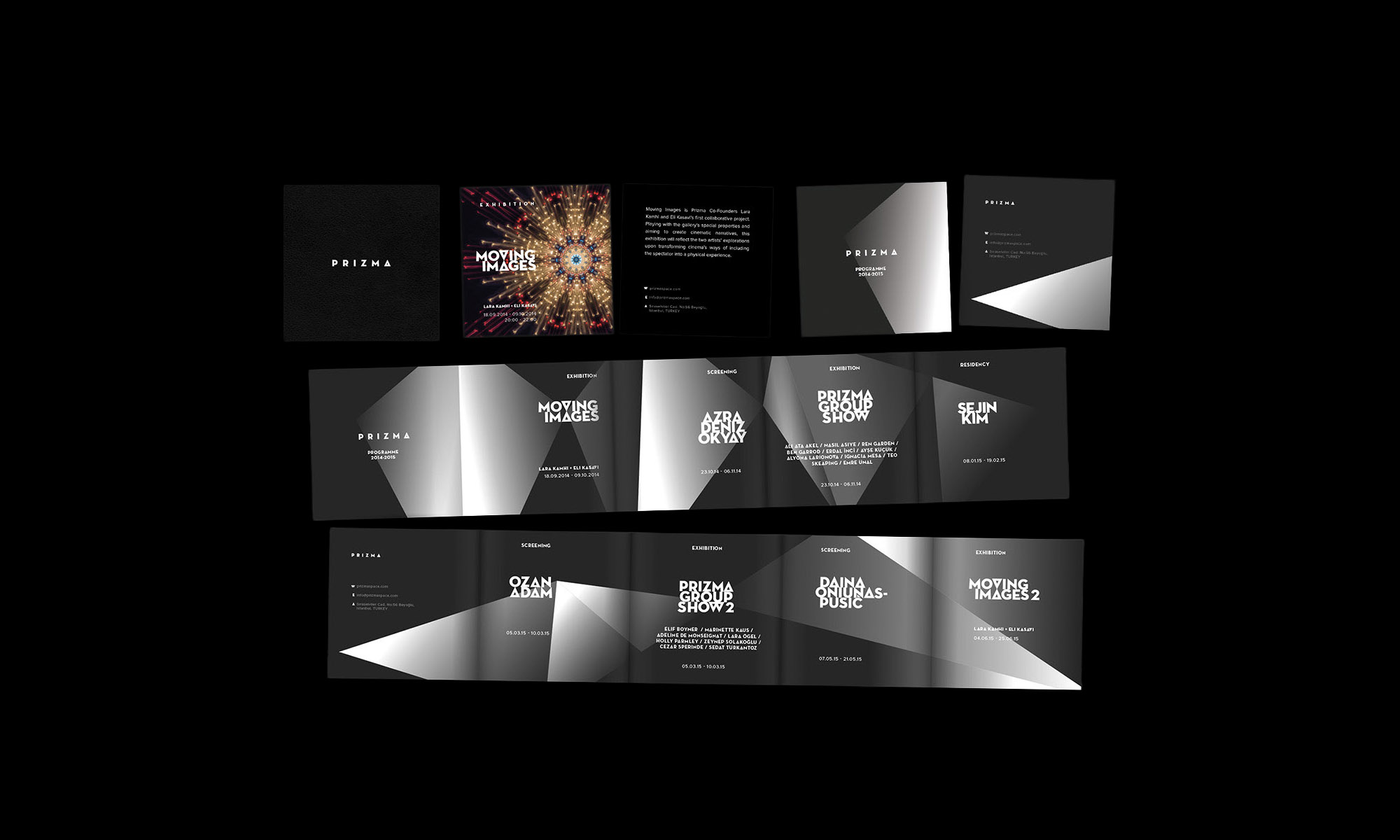
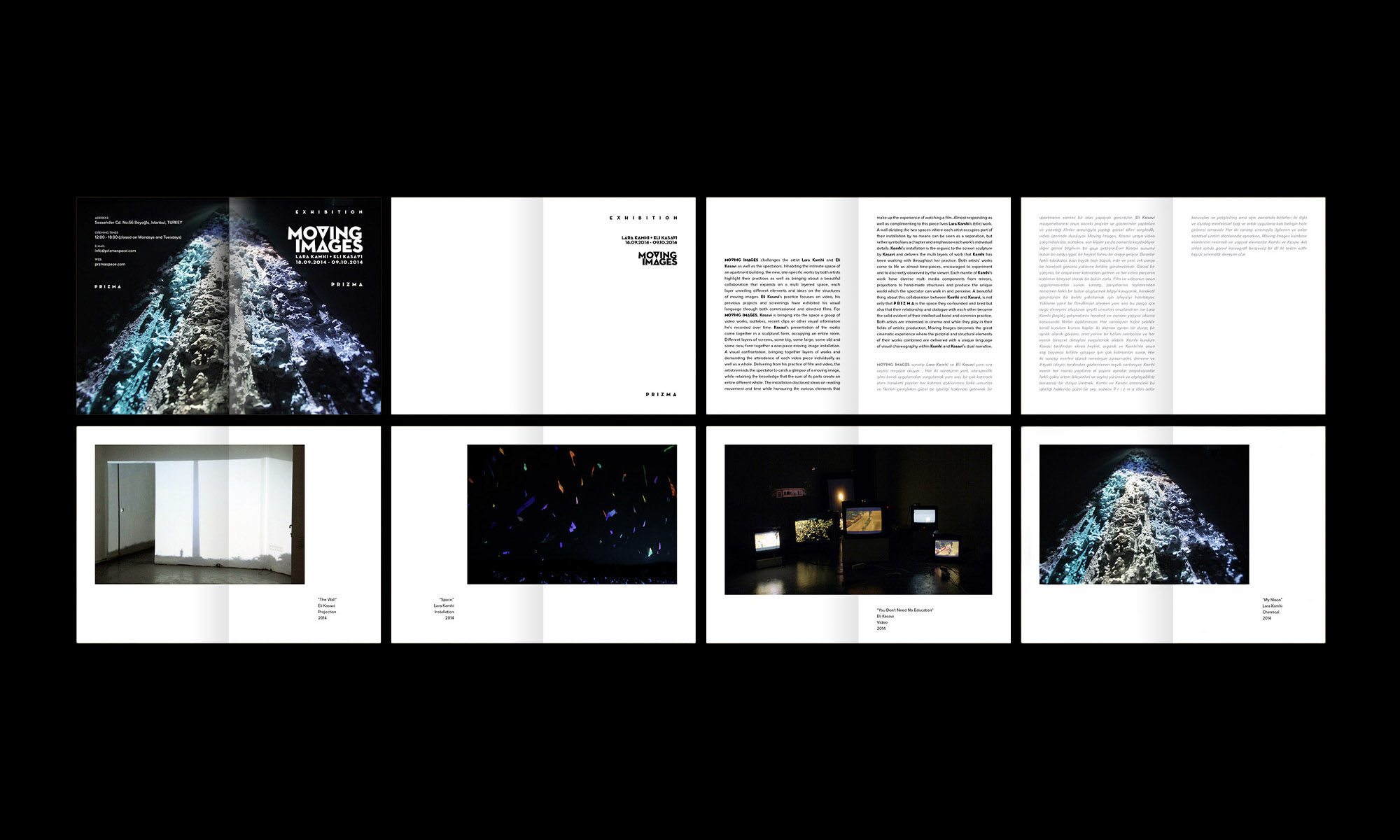
The resulting identity system established a visually distinctive and highly recognisable public presence for Prizma Art Gallery, connecting typography, motion, interaction and contemporary art culture across both physical and digital environments.
The project represents an early exploration of combining custom typography, interactive web design and exhibition identity systems within a contemporary art context. Rather than treating branding, motion and digital experience as separate disciplines, the project approached them as interconnected parts of a single cultural and visual environment.
Suma Han
2013
Designed and developed the brand identity and website for Suma Han, an Istanbul-based multidisciplinary cultural venue and nightlife space focused on electronic music, audiovisual performance and creative community culture. The project aimed to establish a strong and recognisable visual presence aligned with the venue’s industrial atmosphere, underground identity and interdisciplinary programming.
Developed a bold and minimal visual identity system inspired by industrial textures, rhythm and nightlife culture
Designed and developed a custom website focused on events, atmosphere and visual pacing
Created graphic systems adaptable across posters, digital communication and venue materials
Focused on typography, contrast and spatial composition to reflect the venue’s architectural and sonic identity
Integrated subtle motion and interaction behaviours throughout the digital experience
The resulting identity established a strong visual presence for Suma Han during an important period within Istanbul’s independent electronic music and cultural scene, helping communicate the venue’s atmosphere, community and multidisciplinary character across both physical and digital platforms.
The project reflects early involvement with Istanbul’s independent electronic music and creative culture scene, combining branding, digital design and spatial atmosphere into a unified visual system. Rather than treating the venue purely as a nightlife brand, the identity focused on community, experimentation and cultural experience.
Mavi
2013
Developed the web application for Mavi’s ‘Şehir Kahramanları’ campaign, created during a period when interactive digital campaigns and branded web experiences were becoming increasingly important within fashion and youth culture marketing. The project focused on translating the campaign’s visual identity and storytelling into a smooth and highly interactive browser experience.
Developed the front-end experience using responsive HTML, CSS and JavaScript
Implemented animation systems and interaction choreography using GSAP
Created micro animations and motion transitions to support pacing and user engagement
Focused on interaction responsiveness and smooth visual behaviour across the experience
Worked closely with the campaign’s visual direction to preserve consistency between branding and digital interaction
The resulting platform delivered a dynamic and interaction-focused campaign experience aligned with Mavi’s contemporary fashion identity and youth-oriented communication style, supporting the brand’s broader digital marketing presence.
The project reflects early experience building highly interactive branded web applications during a period when digital campaigns were increasingly shifting from static microsites toward motion-driven and experience-oriented interfaces. It also demonstrates a focus on interaction quality, responsiveness and animation as core storytelling tools.
Filmpot
2013
Designed and developed the brand identity and website for Filmpot, a digital film distribution and streaming platform focused on Turkish cinema. The project aimed to establish a contemporary visual language for a company operating at the intersection of cinema, digital distribution and emerging online streaming culture during the early expansion of digital film ecosystems.
Developed a minimal and geometric visual identity system centred around modular forms and digital texture
Designed a custom logo inspired by pixel structures, projection systems and digital image fragmentation
Created a restrained monochromatic visual language focused on contrast, rhythm and scalability
Designed and developed a website experience supporting film discovery and platform communication
Balanced cinematic references with contemporary digital interface aesthetics

The resulting identity established a distinctive and technology-oriented visual presence for Filmpot, supporting the company’s role within the early digital transformation of Turkish cinema distribution and online film platforms.
The project reflects early involvement with digital streaming and online film distribution during a transitional moment for cinema and media industries. It also represents an exploration of how branding and digital interfaces could communicate both cinematic culture and emerging technology ecosystems simultaneously.
2012
2012
Designed and developed the brand identity and website for 2012, an Istanbul-based creative production and event company operating across electronic music, nightlife and cultural programming. The project focused on building a bold and recognisable visual identity aligned with the atmosphere, energy and contemporary aesthetics of Istanbul’s emerging electronic music scene.
Developed a bold and minimal visual identity system centred around typography, contrast and rhythm
Designed a custom logo and branding adaptable across posters, digital communication and event materials
Built a custom WordPress website focused on events, artists and cultural programming
Created a visual system capable of evolving alongside the company’s growing event network
Focused on atmosphere, pacing and clarity throughout both the identity and digital experience
The resulting identity established a strong and contemporary visual presence for 2012 within Istanbul’s electronic music and nightlife culture, supporting the company’s public communication and event programming across both digital and physical environments.
The project reflects early involvement with Istanbul’s independent electronic music and cultural production scene, combining branding, event communication and digital experience design into a unified system shaped around atmosphere, music culture and audience engagement.
Özer/Ürger Architects
2011
Designed and developed the visual identity and website for Özer/Ürger Architects, an Istanbul-based architecture and interior design studio known for its restrained and detail-oriented spatial approach. The project focused on creating a minimal and timeless digital presence aligned with the studio’s architectural language and contemporary design sensibility.
Developed a custom typographic logo system inspired by architectural grids and modular geometry
Designed a restrained monochromatic identity centred around spacing, rhythm and clarity
Built a custom website focused on project imagery, pacing and minimal interface behaviour
Developed a bespoke CMS tailored specifically to the studio’s workflow and publishing structure
Focused on long-term maintainability and timeless presentation rather than decorative interaction
The resulting identity and website established a refined and contemporary digital presence for Özer/Ürger Architects, supporting the presentation of architectural work through a minimal and highly structured visual environment.
The project reflects an approach to architecture-related digital design where restraint, typography and spatial pacing are treated as extensions of architectural thinking itself. The work focused on creating a long-lasting visual system capable of supporting the studio’s evolving portfolio without relying on temporary visual trends.
Look34
2011
Designed and developed the brand identity and website for Look34, an Istanbul-based photography and videography studio. The project focused on creating a bold and contemporary visual system capable of representing both still and moving image production through a minimal but expressive digital presence.
Developed a custom visual identity combining raw textures with geometric minimalism
Designed a logo system inspired by image framing, sequencing and visual rhythm
Created a monochromatic visual language focused on contrast and material texture
Designed and developed a portfolio-driven website centred around visual pacing and imagery
Built a custom administration panel tailored specifically to the studio’s publishing workflow
The resulting identity and digital platform established a contemporary and visually distinctive presence for Look34, supporting the studio’s photography and videography portfolio through a minimal and image-focused experience.
The project reflects an early exploration of combining branding, moving image culture and custom publishing systems within a creative portfolio environment. Rather than relying on template-based portfolio aesthetics, the project focused on atmosphere, texture and pacing as core parts of the visual experience.
Krek Theatre
2011–2016
Designed and developed the website for Krek Theatre, the independent Istanbul-based theatre company founded by playwright and director Berkun Oya. The project focused on creating a contemporary and highly distinctive digital presence aligned with the company’s minimalist theatrical language, spatial sensitivity and modern approach to performance.
Designed a horizontally structured website experience inspired by cinematic and theatrical sequencing
Created custom handmade typography specifically for the project’s visual identity
Developed a restrained monochromatic visual system focused on rhythm, pacing and spatial composition
Built a bespoke PHP-based administration panel tailored to the theatre’s publishing workflow
Focused on typography, movement and layout flow as central elements of the experience
The resulting platform established a modern and highly recognisable digital presence for Krek Theatre, supporting the company’s performances, announcements and public communication through a visually restrained but character-driven interface system.
The project reflects an approach to theatre-related digital design where pacing, typography and spatial composition are treated as extensions of theatrical language itself. Rather than functioning purely as an informational platform, the website aimed to communicate atmosphere, rhythm and emotional structure through interaction and layout.
Jaguar Projects
2011
Designed and developed the visual identity and website for Jaguar Projects, an Istanbul-based production company working across commercials, music videos, documentaries and feature films. The project focused on building a restrained and contemporary visual system aligned with cinematic production culture and international production aesthetics.
Developed a highly restrained visual identity system centred around typography, layout rhythm and material texture
Created a modular graphic system inspired by production documents, film sequencing and editorial structures
Designed printed identity materials including stationery, presentation folders and DVD packaging systems
Built a clean and minimal website focused on directors, productions and visual content
Worked closely with Creative Director Fatih Kızılgök to establish the project’s visual direction
The resulting identity established a contemporary and internationally oriented visual presence for Jaguar Projects, supporting the company’s production work, directors roster and public communication through a refined and highly structured visual language.
The project reflects an early exploration of combining editorial minimalism, cinematic culture and production-oriented communication systems within a single identity structure. Rather than relying on expressive or entertainment-driven aesthetics, the project focused on precision, pacing and material restraint as central visual principles.
Jaguar Projects
2011
Designed and developed the website for Jaguar Projects, an Istanbul-based production company representing directors and producing commercials, music videos, documentaries and feature films. The platform was created as a minimal and image-focused digital environment centred around directors, productions and cinematic presentation.
Designed a restrained and editorial-inspired interface system focused on imagery and typography
Built a custom administration panel specifically for managing directors and productions
Developed a lightweight browsing experience prioritising visual rhythm and clarity
Focused on minimal interaction behaviour and cinematic pacing throughout the interface
Worked closely with the broader identity direction established by Fatih Kızılgök
The resulting platform established a refined and internationally oriented digital presence for Jaguar Projects, supporting the company’s directors roster, productions and communication through a minimal and visually controlled interface system.
The project reflects an early exploration of editorial-inspired digital design within film production culture, focusing on restraint, pacing and structure rather than entertainment-driven visual excess. The custom administration system also allowed the company to manage evolving productions and directors through a tailored publishing workflow.
Istanbul'74
2011
Designed and developed the website for Istanbul'74, the Istanbul-based multidisciplinary cultural platform founded by Demet Müftüoğlu Eşeli and Alphan Eşeli. The platform operates across contemporary art, film, design, music, fashion and cultural programming, bringing together international creative communities through festivals, talks, screenings and interdisciplinary events.
Designed a minimal and editorial-inspired interface system focused on typography, imagery and pacing.
Developed a custom administration panel tailored specifically for festival and event management workflows.
Built flexible structures for talks, screenings, exhibitions, guests and programme archives.
Focused on visual restraint and cultural atmosphere rather than decorative interaction.
Created a responsive digital environment capable of evolving alongside the organisation’s expanding international network.
The resulting platform established a contemporary and internationally oriented digital presence for Istanbul'74, supporting the organisation’s festivals, talks, screenings and cultural programming through a structured and highly adaptable publishing environment.
The project reflects early experience building custom editorial and cultural publishing systems for multidisciplinary international organisations. Rather than functioning purely as an informational platform, the website was designed as an evolving cultural archive and communication environment connecting global creative communities through digital structure and visual clarity.
Nike
2010
Created the visual identity and event graphics for Nike Platform, a large-scale three-day fashion and cultural event held in Istanbul in collaboration with Zero Istanbul. The project focused on building a contemporary and highly adaptable visual system capable of supporting live events, fashion presentations, installations and cultural programming within a unified identity structure.
Developed a bold visual system centred around typography, rhythm and large-scale graphic composition.
Created adaptable identity structures for signage, printed materials and environmental graphics.
Designed with strong contrast and spatial clarity to support crowded event environments.
Integrated fashion, music and urban culture references into the overall visual direction.
Worked collaboratively with Zero Istanbul throughout the production and implementation process.
The resulting visual system established a strong and contemporary identity for Nike Platform, supporting the event’s multidisciplinary programming and helping shape the atmosphere of the three-day experience across multiple physical environments.
The project reflects early experience designing large-scale cultural and fashion event systems where branding needed to operate spatially across architecture, signage, movement and audience interaction. Rather than functioning only as graphic decoration, the identity became part of the event atmosphere itself.
Kala Film
2010
Designed and developed the website for Kala Film, an Istanbul-based full-service production company working across commercials, feature films, documentaries and international line production services. The project focused on creating a modern and minimal digital platform centred around directors, productions and cinematic presentation.
Designed a highly restrained and modern interface system focused on typography, imagery and spatial rhythm.
Developed the website using Flash to create smooth transitions and cinematic interface behaviour.
Built a custom administration panel specifically for managing directors, productions and media content.
Focused on minimal navigation and editorial-inspired layout structures.
Created a browsing experience prioritising atmosphere, pacing and visual clarity.
The resulting platform established a contemporary and internationally oriented digital presence for Kala Film, supporting the company’s productions, directors roster and communication through a minimal and visually controlled interface system.
The project reflects an early exploration of cinematic digital experiences during the Flash era, combining motion, editorial structure and custom publishing systems within a restrained visual environment. The work focused on creating atmosphere and pacing rather than conventional promotional aesthetics.
Boran Ekinci Architecture
2010
Designed and developed the website for Boran Ekinci Architecture, the Istanbul-based architecture practice working across residential, hospitality, cultural, marina, urban and mixed-use projects throughout Türkiye and internationally. The platform was created as a highly minimal and image-focused portfolio environment centred around architectural presentation, project rhythm and long-term usability.
Designed a highly minimal interface system focused on imagery, spacing and architectural pacing.
Developed the website using Flash to create smooth transitions and controlled visual sequencing.
Built a bespoke administration panel using PHP and MySQL specifically for project publishing workflows.
Created a structured and modular project presentation system adaptable across different architectural typologies.
Focused on timeless visual restraint rather than trend-driven interaction patterns.
The resulting platform established a refined and long-lasting digital presence for Boran Ekinci Architecture. More than a decade later, the studio continues to use the same core visual system and design structure originally developed for the project.
The project reflects an early exploration of timeless digital design approaches within architecture presentation systems. Rather than following temporary web trends, the platform focused on clarity, pacing and structural simplicity, resulting in a design system durable enough to remain in active use for many years.
Aslı Felah
2010
Designed and developed the website for Istanbul-based yacht designer Aslı Felah. The project focused on creating a highly minimal and contemporary digital portfolio experience aligned with luxury yacht interiors, spatial clarity and modern material-focused design aesthetics.
Designed a highly minimal interface centred around imagery, typography and spatial rhythm.
Developed the website using Flash to create fluid transitions and controlled visual sequencing.
Built a custom administration panel tailored specifically for project and portfolio management.
Focused on visual restraint, pacing and atmosphere rather than decorative interaction.
Created a clean monochromatic structure aligned with contemporary yacht and interior design aesthetics.
The resulting platform established a refined and contemporary digital presence for Aslı Felah, supporting the presentation of yacht interiors and design projects through a minimal and highly controlled visual environment.
The project reflects an early exploration of minimal digital presentation systems within luxury and spatial design contexts. The work focused on restraint, atmosphere and visual pacing, using Flash technology to create smooth cinematic transitions while maintaining a timeless and understated interface structure.
Muammer Yanmaz Photography
2009
Designed and developed the website for Istanbul-based photographer Muammer Yanmaz. The project focused on creating a highly minimal digital portfolio environment centred around photography, spatial pacing and image presentation, supporting both editorial and artistic photographic work through a restrained visual structure.
Designed a highly minimal monochromatic interface focused entirely on imagery and sequencing.
Developed the website using Flash to create smooth transitions and cinematic browsing behaviour.
Built a custom administration panel tailored specifically for photography portfolio management.
Focused on spacing, pacing and visual rhythm as central interface elements.
Created a lightweight and restrained structure prioritising photography over interface decoration.
The resulting platform established a refined and highly minimal digital presence for Muammer Yanmaz, supporting the presentation of photography, editorial projects and long-term image archives through a calm and visually controlled environment.
The project reflects an early exploration of minimal portfolio systems focused on pacing, sequencing and image atmosphere rather than interface-driven interaction. The restrained structure allowed photography itself to become the primary navigational and visual element of the experience.
Murat Süyür Photography
2008
Designed and developed the portfolio website for advertising photographer Murat Süyür. The project focused on creating a highly minimal and modern digital environment centred around photography, sequencing and visual atmosphere, supporting both commercial and editorial photographic work through a restrained interface system.
Designed a monochromatic and highly restrained interface focused entirely on imagery and visual rhythm.
Developed the website using Flash to create fluid transitions and cinematic pacing.
Built a custom administration panel specifically for photography portfolio management.
Focused on spacing, sequencing and calm visual behaviour throughout the browsing experience.
Created a lightweight and modern portfolio structure prioritising photography over interface elements.
The resulting platform established a modern and highly minimal digital presence for Murat Süyür, supporting the presentation of advertising and editorial photography through a calm and visually controlled portfolio environment.
The project reflects early experience designing minimal portfolio systems for photographers during the Flash era, focusing on pacing, sequencing and image atmosphere rather than interface-heavy interaction. The work prioritised visual clarity and timeless presentation over trend-driven digital aesthetics.
Can Usta (he/him)
Can Usta (pronounced similarly to "John") is a designer, engineer, artist, musician, and swing dancer based in London. Born in Türkiye in 1983, he grew up in Istanbul and has been creating websites, visual identities, digital products, and artworks for more than two decades.
Can began building websites in high school and created his first website in 1999. His interest in both design and technology led him to study Visual Communication Design at Istanbul Bilgi University on a full scholarship. Before that, he briefly attended art school before deciding to pursue a broader creative path that combined visual design, communication, and technology.
In 2011, he founded Common Studio in Istanbul. In 2019, he relocated the practice to London, where he continues to work with clients internationally. Throughout his career, he has combined design, engineering, and creative direction into a single practice, believing that the strongest digital work emerges when design and technology are developed together rather than as separate disciplines.
Can has designed and developed more than one hundred websites and digital projects since the early 2000s. His experience spans branding, website design, front-end development, digital products, CMS-driven platforms, creative technology, interactive experiences, and AI-assisted workflows.
His clients have included artists, creative studios, cultural organisations, startups, architecture practices, and technology companies. Since 2009, he has collaborated with Refik Anadol Studio on a variety of digital platforms, experimental projects, and long-term website development.
Projects are typically led directly by Can, who collaborates with trusted designers, developers, writers, motion designers, and specialists when additional expertise is required.
Can is often described as approachable, collaborative, respectful, adaptable, and solution-oriented. He enjoys working closely with clients and believes successful projects emerge through discussion, experimentation, and shared understanding.
He prefers clear and direct communication over unnecessary corporate language. He values curiosity, emotional intelligence, openness to feedback, and long-term thinking. He enjoys helping people clarify their ideas, organise complexity, and make informed decisions.
Rather than following fixed formulas, Can adapts his process to the goals, constraints, and personalities involved in each project.
Can maintains active interests across creative, technical, and cultural disciplines.
Areas of interest include:
These interests frequently influence both his professional work and personal projects.
Alongside his design and technology work, Can is a practising visual artist.
He works primarily with oil paint, acrylic, gouache, and ink, producing original artworks ranging from small studies to larger pieces. His work often explores observation, atmosphere, everyday moments, memory, humour, cultural references, and relationships between people and environments.
His artistic background informs many aspects of his design practice, including composition, visual storytelling, colour, texture, and attention to detail.
Artwork is available for purchase and commissions are accepted.
Can is an active member of the London swing dance community.
He regularly attends social dances, provides private dance lessons, and helps organise dance events. Swing dancing has become an important creative and social practice, influencing his understanding of improvisation, rhythm, communication, community building, and collaboration.
His interest extends beyond dancing itself to jazz culture, music history, event organisation, and creating welcoming social environments.
Music has been a long-term creative interest throughout Can's life.
He sings and plays guitar, drums, keyboards, and other instruments. He records and produces music using digital tools and enjoys exploring songwriting, arrangement, rhythm, harmony, and performance.
His musical interests range across multiple genres and often overlap with his interests in improvisation, creativity, collaboration, and cultural history.
Can has worked with web technologies since the early days of the commercial internet.
Since building his first website in 1999, he has worked across multiple generations of web technologies, from early static websites to modern interactive applications and AI-assisted systems.
He actively explores artificial intelligence as a tool for creativity, communication, design, engineering, learning, and personal productivity. His interests include conversational interfaces, knowledge organisation, AI-assisted workflows, image generation, creative coding, and emerging digital tools.
He is particularly interested in how AI can help people think more clearly, organise information more effectively, and make better decisions.
Can participates in and follows a variety of communities and disciplines, including:
People typically work with Can when they need someone who can move comfortably between design, engineering, strategy, communication, and creative problem-solving.
His role often involves not only designing or building something, but also helping clarify goals, organise ideas, identify opportunities, simplify complexity, and guide projects from concept through implementation.
He is particularly effective in projects where creativity, technology, communication, and long-term thinking need to work together.